
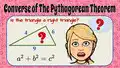
Converse of the Pythagorean Theorem and Triangle Inequality Theorem

Interactive Video
•
Mathematics
•
10th - 12th Grade
•
Hard

Wayground Content
FREE Resource
Read more
10 questions
Show all answers
1.
OPEN ENDED QUESTION
3 mins • 1 pt
What are the three conditions that must be satisfied for three side lengths to form a triangle according to the triangle inequality theorem?
Evaluate responses using AI:
OFF
2.
OPEN ENDED QUESTION
3 mins • 1 pt
In the context of the triangle inequality theorem, explain what it means for two sides to be equal to the length of the third side.
Evaluate responses using AI:
OFF
3.
OPEN ENDED QUESTION
3 mins • 1 pt
Given the side lengths of 7 inches, 8 inches, and 15 inches, can these lengths form a triangle? Justify your answer using the triangle inequality theorem.
Evaluate responses using AI:
OFF
4.
OPEN ENDED QUESTION
3 mins • 1 pt
How can you use the triangle inequality theorem to determine if a triangle can be formed from the lengths 4 inches, 5 inches, and 6 inches?
Evaluate responses using AI:
OFF
5.
OPEN ENDED QUESTION
3 mins • 1 pt
What is the converse of the Pythagorean theorem and how is it applied?
Evaluate responses using AI:
OFF
6.
OPEN ENDED QUESTION
3 mins • 1 pt
Explain how you can determine if a triangle is a right triangle using the converse of the Pythagorean theorem.
Evaluate responses using AI:
OFF
7.
OPEN ENDED QUESTION
3 mins • 1 pt
What is the significance of the longest side when using the Pythagorean theorem to classify triangles?
Evaluate responses using AI:
OFF
Access all questions and much more by creating a free account
Create resources
Host any resource
Get auto-graded reports

Continue with Google

Continue with Email

Continue with Classlink

Continue with Clever
or continue with

Microsoft
%20(1).png)
Apple

Others
Already have an account?


