
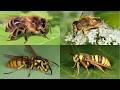
Identifying Insects: Bees, Flies, and Moths

Interactive Video
•
Biology, Science
•
6th - 8th Grade
•
Practice Problem
•
Hard

Ethan Morris
FREE Resource
Read more
8 questions
Show all answers
1.
MULTIPLE CHOICE QUESTION
30 sec • 1 pt
What is a common misconception about the appearance of bees?
All bees are yellow and black striped.
Bees have long feathery antennae.
Bees have two wings.
Bees are mostly bald.
2.
MULTIPLE CHOICE QUESTION
30 sec • 1 pt
Which of the following insects are often mistaken for bees due to their appearance?
Flies
Grasshoppers
Ants
Butterflies
3.
MULTIPLE CHOICE QUESTION
30 sec • 1 pt
Why do some stinging species like bees and wasps have similar appearances?
To find food easily
To avoid predators
To confuse humans
To attract mates
4.
MULTIPLE CHOICE QUESTION
30 sec • 1 pt
What is the benefit for non-stinging insects to mimic the appearance of stinging insects?
To fly faster
To pollinate flowers
To gain protection from predators
To produce honey
5.
MULTIPLE CHOICE QUESTION
30 sec • 1 pt
Which characteristic is NOT used to identify a bee?
Short, elbow-shaped antennae
Four wings
Super-hairy body
Long feathery antennae
6.
MULTIPLE CHOICE QUESTION
30 sec • 1 pt
What feature distinguishes a fly from a bee or wasp?
Long feathery antennae
Two wings and giant goggles
Four wings and hairy body
Short antennae and bald body
7.
MULTIPLE CHOICE QUESTION
30 sec • 1 pt
If an insect has long feathery antennae, what is it likely to be?
A moth
A wasp
A bee
A fly
Access all questions and much more by creating a free account
Create resources
Host any resource
Get auto-graded reports

Continue with Google

Continue with Email

Continue with Microsoft
or continue with

%20(1).png)
Apple

Others
Already have an account?

