
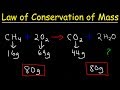
The Law of Conservation of Mass Explained Through Chemical Reactions

Interactive Video
•
Chemistry, Science, Physics
•
9th - 10th Grade
•
Practice Problem
•
Hard

Patricia Brown
FREE Resource
Read more
10 questions
Show all answers
1.
MULTIPLE CHOICE QUESTION
30 sec • 1 pt
What is the main principle of the law of conservation of mass?
Matter can be created or destroyed in a chemical reaction.
Matter cannot be created or destroyed in a chemical reaction.
Energy can be created or destroyed in a chemical reaction.
Energy cannot be created or destroyed in a chemical reaction.
2.
MULTIPLE CHOICE QUESTION
30 sec • 1 pt
In the example given, what are the initial masses of methane and oxygen?
16 grams of methane and 64 grams of oxygen
32 grams of methane and 64 grams of oxygen
64 grams of methane and 16 grams of oxygen
16 grams of methane and 32 grams of oxygen
3.
MULTIPLE CHOICE QUESTION
30 sec • 1 pt
What is the total mass of reactants in the closed container before the reaction?
64 grams
80 grams
44 grams
100 grams
4.
MULTIPLE CHOICE QUESTION
30 sec • 1 pt
How much water is expected to be produced if 44 grams of carbon dioxide is collected?
44 grams
36 grams
16 grams
80 grams
5.
MULTIPLE CHOICE QUESTION
30 sec • 1 pt
What happens to atoms during a chemical reaction according to the law of conservation of mass?
Atoms disappear.
Atoms are created.
Atoms are destroyed.
Atoms rearrange themselves.
6.
MULTIPLE CHOICE QUESTION
30 sec • 1 pt
In the reaction example, what does the carbon atom bond with after the reaction?
Hydrogen
Oxygen
Nitrogen
Sulfur
7.
MULTIPLE CHOICE QUESTION
30 sec • 1 pt
What remains constant in a chemical reaction in a closed system?
The number of atoms
The total mass
The volume
The temperature
Access all questions and much more by creating a free account
Create resources
Host any resource
Get auto-graded reports

Continue with Google

Continue with Email

Continue with Microsoft
or continue with

%20(1).png)
Apple

Others
Already have an account?



