
Ecological Tolerance and Survival Strategies in Organisms

Interactive Video
•
Biology, Science, Geography
•
9th - 10th Grade
•
Practice Problem
•
Hard

Patricia Brown
FREE Resource
Read more
8 questions
Show all answers
1.
MULTIPLE CHOICE QUESTION
30 sec • 1 pt
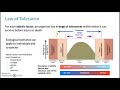
What does the law of tolerance state about organisms and abiotic factors?
Organisms can survive in any condition.
Organisms have a range of tolerances for each abiotic factor.
Organisms are unaffected by abiotic factors.
Organisms can only survive in their ideal conditions.
2.
MULTIPLE CHOICE QUESTION
30 sec • 1 pt
Which of the following is NOT considered an abiotic factor?
Sunlight
Predation
Temperature
Salinity
3.
MULTIPLE CHOICE QUESTION
30 sec • 1 pt
What is the term for the range outside an organism's optimum range where it can still survive?
Survival zone
Ideal range
Tolerance range
Zone of death
4.
MULTIPLE CHOICE QUESTION
30 sec • 1 pt
What happens to organisms outside their tolerance range?
They become more adaptable.
They experience physiological stress.
They thrive and reproduce.
They find new habitats easily.
5.
MULTIPLE CHOICE QUESTION
30 sec • 1 pt
How do generalist species differ from specialist species in terms of resource use?
Generalists use a narrow range of resources.
Specialists can survive in any condition.
Specialists can use a wide variety of resources.
Generalists can use a wide variety of resources.
6.
MULTIPLE CHOICE QUESTION
30 sec • 1 pt
What is a likely consequence of habitat loss on specialist species?
They increase in number due to less competition.
They adapt quickly to new environments.
They thrive in the absence of competition.
They are the first to decline as resources become unavailable.
7.
MULTIPLE CHOICE QUESTION
30 sec • 1 pt
Which species is more likely to survive in a changing environment?
Specialist species
Generalist species
Neither, both are equally likely
Species with no specific diet
Access all questions and much more by creating a free account
Create resources
Host any resource
Get auto-graded reports

Continue with Google

Continue with Email

Continue with Classlink

Continue with Clever
or continue with

Microsoft
%20(1).png)
Apple

Others
Already have an account?

