
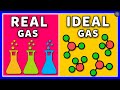
Real Versus Ideal Gases: Key Concepts and Conditions

Interactive Video
•
Physics, Chemistry, Science
•
9th - 10th Grade
•
Practice Problem
•
Hard

Patricia Brown
FREE Resource
Read more
10 questions
Show all answers
1.
MULTIPLE CHOICE QUESTION
30 sec • 1 pt
Which of the following is NOT an example of a real gas?
Helium
Ideal Gas
Oxygen
Carbon Dioxide
2.
MULTIPLE CHOICE QUESTION
30 sec • 1 pt
Under what conditions can hydrogen gas behave like an ideal gas?
High pressure and high temperature
Low pressure and low temperature
Low pressure and high temperature
High pressure and low temperature
3.
MULTIPLE CHOICE QUESTION
30 sec • 1 pt
What happens to the molecules of hydrogen gas at low pressure?
They form a liquid
They move closer together
They move further apart
They remain stationary
4.
MULTIPLE CHOICE QUESTION
30 sec • 1 pt
Which of the following is true about ideal gases?
Their collisions are non-elastic
Their volume is negligible
They have significant intermolecular forces
They do not follow the ideal gas equation
5.
MULTIPLE CHOICE QUESTION
30 sec • 1 pt
In real gases, what type of collision occurs between molecules?
Perfectly elastic
Non-elastic
Explosive
No collision
6.
MULTIPLE CHOICE QUESTION
30 sec • 1 pt
Which of the following is NOT a characteristic of an ideal gas?
Negligible volume
Perfectly elastic collisions
Significant intermolecular forces
Follows PV = nRT
7.
MULTIPLE CHOICE QUESTION
30 sec • 1 pt
Why do we study ideal gases?
To calculate the weight of gases
To understand the behavior of all gases
To ignore real gas behavior
Because they exist in nature
Access all questions and much more by creating a free account
Create resources
Host any resource
Get auto-graded reports

Continue with Google

Continue with Email

Continue with Classlink

Continue with Clever
or continue with

Microsoft
%20(1).png)
Apple

Others
Already have an account?

