
Mastering Dilution Calculations in Chemistry

Interactive Video
•
Chemistry, Mathematics, Science
•
9th - 12th Grade
•
Practice Problem
•
Hard

Patricia Brown
FREE Resource
Read more
10 questions
Show all answers
1.
MULTIPLE CHOICE QUESTION
30 sec • 1 pt
What happens to the number of moles of solute when a solution is diluted?
It remains the same.
It decreases.
It increases.
It doubles.
2.
MULTIPLE CHOICE QUESTION
30 sec • 1 pt
Which equation represents the relationship between initial and final concentrations and volumes in a dilution?
m1 + v1 = m2 + v2
m1 - v1 = m2 - v2
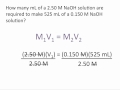
m1v1 = m2v2
m1/v1 = m2/v2
3.
MULTIPLE CHOICE QUESTION
30 sec • 1 pt
Why is it important for initial and final concentrations to have the same units?
To make the solution more concentrated.
To ensure the equation m1v1 = m2v2 is valid.
To decrease the number of moles of solute.
To increase the volume of the solution.
4.
MULTIPLE CHOICE QUESTION
30 sec • 1 pt
What must be true about the units of initial and final volumes in a dilution problem?
They must be in liters.
They must be in milliliters.
They must be different.
They must have the same units.
5.
MULTIPLE CHOICE QUESTION
30 sec • 1 pt
In the first example, what is the final volume of the diluted NaOH solution?
525 milliliters
31.5 milliliters
0.150 liters
2.5 liters
6.
MULTIPLE CHOICE QUESTION
30 sec • 1 pt
How many milliliters of a 2.5 molar NaOH solution are needed to make 525 milliliters of a 0.15 molar solution?
52.5 milliliters
150 milliliters
31.5 milliliters
525 milliliters
7.
MULTIPLE CHOICE QUESTION
30 sec • 1 pt
In the second example, what is the initial concentration of the HCl solution?
6 molar
0.250 molar
1.08 molar
0.150 molar
Access all questions and much more by creating a free account
Create resources
Host any resource
Get auto-graded reports

Continue with Google

Continue with Email

Continue with Classlink

Continue with Clever
or continue with

Microsoft
%20(1).png)
Apple

Others
Already have an account?

