
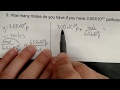
Converting Particles to Moles in Chemistry Calculations

Interactive Video
•
Mathematics, Physics, Chemistry
•
9th - 10th Grade
•
Practice Problem
•
Hard

Patricia Brown
FREE Resource
Read more
8 questions
Show all answers
1.
MULTIPLE CHOICE QUESTION
30 sec • 1 pt
What is the given value in the problem discussed?
0.5 moles
1 mole
3.00 times 10 to the 23rd particles
6.02 times 10 to the 23rd particles
2.
MULTIPLE CHOICE QUESTION
30 sec • 1 pt
What is the unknown value that needs to be calculated?
Particles
Moles
Grams
Liters
3.
MULTIPLE CHOICE QUESTION
30 sec • 1 pt
Which of the following is a correct conversion factor for particles to moles?
1 mole over 3.00 times 10 to the 23rd particles
6.02 times 10 to the 23rd particles over 1 mole
1 mole over 6.02 times 10 to the 23rd particles
3.00 times 10 to the 23rd particles over 1 mole
4.
MULTIPLE CHOICE QUESTION
30 sec • 1 pt
Why is it important to have particles in the denominator when using the conversion factor?
To ensure particles are added
To ensure particles are canceled
To ensure particles are subtracted
To ensure particles are multiplied
5.
MULTIPLE CHOICE QUESTION
30 sec • 1 pt
What is the first step in the calculation process?
Write down the given
Divide the given by the conversion factor
Write down the unknown
Multiply the given by the conversion factor
6.
MULTIPLE CHOICE QUESTION
30 sec • 1 pt
What is the result of dividing 3.00 by 6.02?
0.5
0.3
1.5
2.0
7.
MULTIPLE CHOICE QUESTION
30 sec • 1 pt
What unit is left after the particles cancel out in the calculation?
Liters
Grams
Moles
Particles
Access all questions and much more by creating a free account
Create resources
Host any resource
Get auto-graded reports

Continue with Google

Continue with Email

Continue with Classlink

Continue with Clever
or continue with

Microsoft
%20(1).png)
Apple

Others
Already have an account?

