
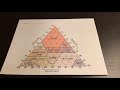
Soil Texture Triangle: Classifying Sand Silt and Clay Percentages

Interactive Video
•
Science, Biology, Mathematics
•
6th - 8th Grade
•
Practice Problem
•
Hard

Patricia Brown
FREE Resource
Read more
10 questions
Show all answers
1.
MULTIPLE CHOICE QUESTION
30 sec • 1 pt
What shape is used to represent the spectrum of soil types between sand, silt, and clay?
Circle
Rectangle
Square
Triangle
2.
MULTIPLE CHOICE QUESTION
30 sec • 1 pt
If you have 60% sand and 20% clay, what percentage of silt should you have?
10%
40%
30%
20%
3.
MULTIPLE CHOICE QUESTION
30 sec • 1 pt
In the soil texture triangle, which direction do you read the lines for sand?
Upwards
Downwards
Diagonally
Horizontally
4.
MULTIPLE CHOICE QUESTION
30 sec • 1 pt
What is the significance of the arrows on the soil texture triangle?
They indicate the direction to read the lines for each soil type.
They show the percentage of each soil type.
They are decorative and have no significance.
They point to the center of the triangle.
5.
MULTIPLE CHOICE QUESTION
30 sec • 1 pt
What is the soil classification if you have 70% silt and 10% sand?
Sandy loam
Clay loam
Silt loam
Loamy sand
6.
MULTIPLE CHOICE QUESTION
30 sec • 1 pt
What percentage of sand is needed to classify a soil as pure sand?
90%
70%
60%
80%
7.
MULTIPLE CHOICE QUESTION
30 sec • 1 pt
What happens if you have 60% clay in your soil?
It is classified as sandy soil.
It is classified as loamy soil.
It is classified as clay soil.
It is classified as silt soil.
Access all questions and much more by creating a free account
Create resources
Host any resource
Get auto-graded reports

Continue with Google

Continue with Email

Continue with Classlink

Continue with Clever
or continue with

Microsoft
%20(1).png)
Apple

Others
Already have an account?


