
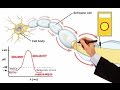
The Dynamics of Neuronal Action Potentials and Ion Movement

Interactive Video
•
Biology, Science, Physics
•
9th - 10th Grade
•
Practice Problem
•
Hard

Patricia Brown
FREE Resource
Read more
10 questions
Show all answers
1.
MULTIPLE CHOICE QUESTION
30 sec • 1 pt
What is the charge difference across a neuron's membrane in its resting state?
The outside is more negative than the inside.
The inside is more positive than the outside.
The inside is more negative than the outside.
There is no charge difference.
2.
MULTIPLE CHOICE QUESTION
30 sec • 1 pt
What triggers the opening of sodium channels in a neuron's membrane?
An increase in light exposure.
A sensory input disturbing the plasma membrane.
A decrease in temperature.
A decrease in pressure.
3.
MULTIPLE CHOICE QUESTION
30 sec • 1 pt
During depolarization, what happens to the charge inside the neuron?
It remains unchanged.
It becomes more negative.
It becomes neutral.
It becomes more positive.
4.
MULTIPLE CHOICE QUESTION
30 sec • 1 pt
Which ions are primarily involved in the depolarization of a neuron?
Magnesium ions
Calcium ions
Chloride ions
Sodium ions
5.
MULTIPLE CHOICE QUESTION
30 sec • 1 pt
What is the threshold voltage that initiates an action potential?
Zero mV
Positive 55 mV
Negative 55 mV
Negative 70 mV
6.
MULTIPLE CHOICE QUESTION
30 sec • 1 pt
What occurs during the repolarization phase of an action potential?
Potassium ions flow out of the cell.
Potassium ions flow into the cell.
Calcium ions flow into the cell.
Sodium ions flow out of the cell.
7.
MULTIPLE CHOICE QUESTION
30 sec • 1 pt
What is the term used to describe the state when the inside of the neuron becomes more negative than the resting state?
Depolarization
Repolarization
Hyperpolarization
Polarization
Access all questions and much more by creating a free account
Create resources
Host any resource
Get auto-graded reports

Continue with Google

Continue with Email

Continue with Classlink

Continue with Clever
or continue with

Microsoft
%20(1).png)
Apple

Others
Already have an account?

