
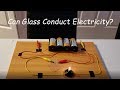
Conductors and Insulators: Exploring Electricity Through Materials

Interactive Video
•
Physics, Science, Chemistry
•
6th - 8th Grade
•
Practice Problem
•
Hard

Patricia Brown
FREE Resource
Read more
10 questions
Show all answers
1.
MULTIPLE CHOICE QUESTION
30 sec • 1 pt
What happens when a conductor is connected between the yellow and red wires in the demonstration?
The wires heat up.
The light bulb remains off.
The light bulb lights up.
The circuit breaks.
2.
MULTIPLE CHOICE QUESTION
30 sec • 1 pt
Why do metals conduct electricity?
They are insulators.
They have free-flowing charged particles.
They have tightly bound electrons.
They have a high resistance.
3.
MULTIPLE CHOICE QUESTION
30 sec • 1 pt
Which of the following materials is an insulator?
Salt water
Metal
Wood
ITO glass
4.
MULTIPLE CHOICE QUESTION
30 sec • 1 pt
What is unique about molten glass compared to solid glass?
Molten glass is an insulator.
Molten glass can conduct electricity.
Molten glass has no resistance.
Molten glass is opaque.
5.
MULTIPLE CHOICE QUESTION
30 sec • 1 pt
What is ITO glass made of?
Iron, tin, and oxide
Indium, tin, and oxide
Iron, titanium, and oxygen
Indium, tungsten, and oxygen
6.
MULTIPLE CHOICE QUESTION
30 sec • 1 pt
How does the distance between wires on ITO glass affect the light bulb?
The light bulb explodes.
The light bulb's brightness decreases.
The light bulb turns off.
The light bulb gets brighter.
7.
MULTIPLE CHOICE QUESTION
30 sec • 1 pt
Why is pure water considered an insulator?
It has free-flowing ions.
It lacks free-flowing charged particles.
It has a high conductivity.
It is a good conductor.
Access all questions and much more by creating a free account
Create resources
Host any resource
Get auto-graded reports

Continue with Google

Continue with Email

Continue with Microsoft
or continue with

%20(1).png)
Apple

Others
Already have an account?

