
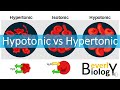
Comparing Hypotonic And Hypertonic Solutions In Biological Contexts

Interactive Video
•
Biology, Science, Chemistry
•
9th - 10th Grade
•
Practice Problem
•
Hard

Patricia Brown
FREE Resource
Read more
10 questions
Show all answers
1.
MULTIPLE CHOICE QUESTION
30 sec • 1 pt
What is the role of water in a biological solution?
It acts as a solute.
It acts as a solvent.
It acts as a catalyst.
It acts as an inhibitor.
2.
MULTIPLE CHOICE QUESTION
30 sec • 1 pt
What characteristic of the cell membrane allows water to pass through but not solutes?
Translucency
Semipermeability
Permeability
Impermeability
3.
MULTIPLE CHOICE QUESTION
30 sec • 1 pt
Which of the following best describes osmosis?
Movement of solutes from high to low concentration
Movement of water from low to high concentration
Movement of water from high to low concentration
Movement of solutes from low to high concentration
4.
MULTIPLE CHOICE QUESTION
30 sec • 1 pt
In a hypotonic solution, what is the concentration of solutes compared to the cell?
Lower than the cell
Equal to the cell
Unrelated to the cell
Higher than the cell
5.
MULTIPLE CHOICE QUESTION
30 sec • 1 pt
What happens to a cell placed in a hypotonic solution over time?
It shrinks.
It remains the same.
It swells and may burst.
It becomes rigid.
6.
MULTIPLE CHOICE QUESTION
30 sec • 1 pt
In a hypertonic solution, what is the concentration of solutes compared to the cell?
Higher than the cell
Unrelated to the cell
Lower than the cell
Equal to the cell
7.
MULTIPLE CHOICE QUESTION
30 sec • 1 pt
What is the effect on a cell placed in a hypertonic solution?
It swells.
It bursts.
It shrinks.
It remains unchanged.
Access all questions and much more by creating a free account
Create resources
Host any resource
Get auto-graded reports

Continue with Google

Continue with Email

Continue with Classlink

Continue with Clever
or continue with

Microsoft
%20(1).png)
Apple

Others
Already have an account?


