
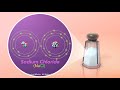
Covalent and Ionic Bond Concepts

Interactive Video
•
Chemistry, Science, Biology
•
9th - 10th Grade
•
Practice Problem
•
Hard

Patricia Brown
FREE Resource
Read more
10 questions
Show all answers
1.
MULTIPLE CHOICE QUESTION
30 sec • 1 pt
What happens to an atom when it gains electrons?
It changes into a different element.
It becomes a positively charged ion.
It becomes a negatively charged ion.
It remains neutral.
2.
MULTIPLE CHOICE QUESTION
30 sec • 1 pt
Why can't you add a proton to make a positive ion?
It would make the atom negatively charged.
It would change the atom into a different element.
It would have no effect on the atom.
It would make the atom unstable.
3.
MULTIPLE CHOICE QUESTION
30 sec • 1 pt
What is the main characteristic of ionic bonds?
Sharing of electron pairs.
Transfer of protons.
Transfer of electrons.
Sharing of protons.
4.
MULTIPLE CHOICE QUESTION
30 sec • 1 pt
In the formation of sodium chloride, what happens to the sodium atom?
It gains an electron and becomes negatively charged.
It remains electrically neutral.
It loses an electron and becomes positively charged.
It shares an electron with chlorine.
5.
MULTIPLE CHOICE QUESTION
30 sec • 1 pt
How do covalent bonds form?
By transferring electrons between atoms.
By sharing pairs of electrons between atoms.
By transferring protons between atoms.
By sharing protons between atoms.
6.
MULTIPLE CHOICE QUESTION
30 sec • 1 pt
What is the simplest substance that contains a covalent bond?
Sodium chloride (NaCl)
Hydrogen gas (H2)
Water (H2O)
Carbon dioxide (CO2)
7.
MULTIPLE CHOICE QUESTION
30 sec • 1 pt
In carbon dioxide, how many pairs of electrons are shared between carbon and each oxygen atom?
Four pairs
One pair
Two pairs
Three pairs
Access all questions and much more by creating a free account
Create resources
Host any resource
Get auto-graded reports

Continue with Google

Continue with Email

Continue with Classlink

Continue with Clever
or continue with

Microsoft
%20(1).png)
Apple

Others
Already have an account?


