
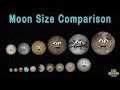
Moons of the Solar System

Interactive Video
•
Science, Geography, Physics
•
6th - 7th Grade
•
Practice Problem
•
Hard

Patricia Brown
FREE Resource
Read more
10 questions
Show all answers
1.
MULTIPLE CHOICE QUESTION
30 sec • 1 pt
What is the primary criterion used to compare the sizes of moons in the Solar System?
Surface Area
Volume
Radius
Mass
2.
MULTIPLE CHOICE QUESTION
30 sec • 1 pt
Which moon orbits Saturn and has a radius of 531 km?
Tethys
Umbriel
Ariel
Dione
3.
MULTIPLE CHOICE QUESTION
30 sec • 1 pt
Which moon is the third largest by radius among the moons of Uranus?
Oberon
Titania
Umbriel
Ariel
4.
MULTIPLE CHOICE QUESTION
30 sec • 1 pt
Which moon orbits Pluto and has a radius of 606 km?
Oberon
Iapetus
Charon
Rhea
5.
MULTIPLE CHOICE QUESTION
30 sec • 1 pt
What is the radius of Triton, the largest moon of Neptune?
1,560 km
1,821 km
1,737 km
1,353 km
6.
MULTIPLE CHOICE QUESTION
30 sec • 1 pt
Which moon is known as the Earth's natural satellite?
Europa
The Moon
Callisto
Io
7.
MULTIPLE CHOICE QUESTION
30 sec • 1 pt
Which moon of Jupiter has a radius of 2,410 km?
Ganymede
Europa
Callisto
Io
Access all questions and much more by creating a free account
Create resources
Host any resource
Get auto-graded reports

Continue with Google

Continue with Email

Continue with Classlink

Continue with Clever
or continue with

Microsoft
%20(1).png)
Apple

Others
Already have an account?


