
Electrolytes and Their Properties

Interactive Video
•
Chemistry, Science, Biology
•
9th - 12th Grade
•
Practice Problem
•
Hard

Patricia Brown
FREE Resource
Read more
10 questions
Show all answers
1.
MULTIPLE CHOICE QUESTION
30 sec • 1 pt
What is the primary characteristic of an electrolyte when dissolved in water?
It dissociates into ions.
It evaporates quickly.
It changes color.
It forms a solid.
2.
MULTIPLE CHOICE QUESTION
30 sec • 1 pt
Which type of electrolyte completely dissociates in solution?
Partial electrolyte
Strong electrolyte
Weak electrolyte
Non-electrolyte
3.
MULTIPLE CHOICE QUESTION
30 sec • 1 pt
How can we categorize substances as strong, weak, or non-electrolytes?
By their color change.
By their taste.
By their boiling point.
By measuring their electrical conductance.
4.
MULTIPLE CHOICE QUESTION
30 sec • 1 pt
What is a key feature of ionic electrolytes like potassium chloride?
They do not dissolve in water.
They form covalent bonds.
They dissociate into cations and anions.
They are non-conductive.
5.
MULTIPLE CHOICE QUESTION
30 sec • 1 pt
How do covalent electrolytes like acetic acid behave in solution?
They undergo a chemical reaction with the solvent.
They evaporate.
They form a precipitate.
They remain unchanged.
6.
MULTIPLE CHOICE QUESTION
30 sec • 1 pt
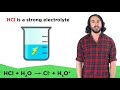
What happens to hydrochloric acid when dissolved in water?
It forms a gas.
It remains a neutral compound.
It completely transfers protons to water molecules.
It becomes a non-electrolyte.
7.
MULTIPLE CHOICE QUESTION
30 sec • 1 pt
What is the role of the solvent in the behavior of electrolytes?
It evaporates quickly.
It accepts or donates protons.
It provides ions.
It acts as a catalyst.
Access all questions and much more by creating a free account
Create resources
Host any resource
Get auto-graded reports

Continue with Google

Continue with Email

Continue with Classlink

Continue with Clever
or continue with

Microsoft
%20(1).png)
Apple

Others
Already have an account?
Similar Resources on Wayground

6 questions
New Mexico Wildfire Prompts Call For U.S. Disaster Declaration
Interactive video
•
9th - 12th Grade
10 questions
China's Economic Growth and Challenges
Interactive video
•
9th - 12th Grade
10 questions
Understanding the Tacoma Narrows Bridge Collapse
Interactive video
•
9th - 12th Grade
11 questions
Hypersonic Sound Technology Applications
Interactive video
•
9th - 12th Grade
11 questions
Writing Techniques and Giant Squid Insights
Interactive video
•
9th - 12th Grade
11 questions
DNA Repair Mechanisms and Damage
Interactive video
•
9th - 12th Grade
11 questions
Understanding the Environmental Impact of Shopping Bags
Interactive video
•
9th - 12th Grade
11 questions
Brain FM and Evolutionary Distractions
Interactive video
•
9th - 12th Grade
Popular Resources on Wayground
8 questions
Spartan Way - Classroom Responsible

Quiz
•
9th - 12th Grade
15 questions
Fractions on a Number Line
Quiz
•
3rd Grade
14 questions
Boundaries & Healthy Relationships

Lesson
•
6th - 8th Grade
20 questions
Equivalent Fractions
Quiz
•
3rd Grade
3 questions
Integrity and Your Health
Lesson
•
6th - 8th Grade
25 questions
Multiplication Facts
Quiz
•
5th Grade
9 questions
FOREST Perception
Lesson
•
KG
20 questions
Main Idea and Details
Quiz
•
5th Grade
Discover more resources for Chemistry
22 questions
Unit 9 Gas Law Quiz
Quiz
•
10th Grade
20 questions
Types of Chemical Reactions
Quiz
•
9th - 12th Grade
13 questions
Solubility Curves
Quiz
•
10th Grade
20 questions
momentum and impulse
Quiz
•
9th - 12th Grade
22 questions
Solubility Curve Practice
Quiz
•
10th Grade
40 questions
Unit 3 (Part 1) Chemical Equations & Reactions Review Game
Quiz
•
8th - 12th Grade
20 questions
Naming Covalent Compounds
Quiz
•
11th Grade
35 questions
Types of Chemical Reactions
Quiz
•
9th - 12th Grade