
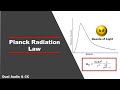
Max Planck and Blackbody Radiation

Interactive Video
•
Physics, Science, Mathematics
•
11th Grade - University
•
Practice Problem
•
Hard

Patricia Brown
FREE Resource
Read more
10 questions
Show all answers
1.
MULTIPLE CHOICE QUESTION
30 sec • 1 pt
What was the main challenge with the blackbody radiation curve that classical physics could not solve?
It predicted too little radiation at high wavelengths.
It predicted too much radiation at low wavelengths.
It could not predict any radiation at all.
It predicted radiation only at medium wavelengths.
2.
MULTIPLE CHOICE QUESTION
30 sec • 1 pt
According to Rayleigh-Jeans Law, how is the energy density of radiation related to frequency and wavelength?
Proportional to the frequency and wavelength.
Proportional to the square of the frequency and inversely proportional to the square of the wavelength.
Inversely proportional to the square of the frequency and proportional to the square of the wavelength.
Inversely proportional to the frequency and wavelength.
3.
MULTIPLE CHOICE QUESTION
30 sec • 1 pt
What was Max Planck's key proposition about the energy of oscillators?
Energy is a multiple of frequency and a constant.
Energy is inversely proportional to frequency.
Energy is proportional to the square of the frequency.
Energy is constant for all oscillators.
4.
MULTIPLE CHOICE QUESTION
30 sec • 1 pt
What constant did Max Planck introduce to solve the blackbody radiation problem?
Boltzmann constant
Avogadro constant
Planck constant
Stefan-Boltzmann constant
5.
MULTIPLE CHOICE QUESTION
30 sec • 1 pt
How does Planck's radiation law differ from Rayleigh-Jeans Law in terms of frequency?
It is proportional to the frequency squared.
It does not depend on frequency.
It is inversely proportional to frequency.
It includes an exponential term of frequency.
6.
MULTIPLE CHOICE QUESTION
30 sec • 1 pt
What happens to the energy density at low wavelengths according to Planck's radiation law?
It follows the curve of the exponential term.
It decreases rapidly.
It follows the curve of 1 by lambda cube.
It remains constant.
7.
MULTIPLE CHOICE QUESTION
30 sec • 1 pt
What is the significance of the peak wavelength in Planck's radiation law?
It is where the blackbody emits no radiation.
It is where the blackbody emits maximum radiation.
It is where the blackbody emits minimum radiation.
It is where the blackbody emits constant radiation.
Access all questions and much more by creating a free account
Create resources
Host any resource
Get auto-graded reports

Continue with Google

Continue with Email

Continue with Classlink

Continue with Clever
or continue with

Microsoft
%20(1).png)
Apple

Others
Already have an account?


