
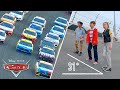
Understanding Banking in Race Tracks

Interactive Video
•
Science, Physics, Mathematics
•
4th - 5th Grade
•
Practice Problem
•
Hard

Patricia Brown
FREE Resource
Read more
10 questions
Show all answers
1.
MULTIPLE CHOICE QUESTION
30 sec • 1 pt
What is the initial reaction of the children to the steep banks at Daytona?
They are scared to go near it.
They think it's not steep at all.
They are surprised by how steep it is.
They are excited to drive on it.
2.
MULTIPLE CHOICE QUESTION
30 sec • 1 pt
What does Riley Herbst say about the steep banks?
They make the track look nice.
They help race cars go faster.
They slow down the cars.
They are just for decoration.
3.
MULTIPLE CHOICE QUESTION
30 sec • 1 pt
What do Max, Victoria, and Yonas plan to explore at the Daytona track?
The history of the track.
The steepness of the banks.
The number of cars racing.
The length of the track.
4.
MULTIPLE CHOICE QUESTION
30 sec • 1 pt
Why do race tracks have steep banks on the turns?
To reduce the number of cars on the track.
To make it easier for spectators to see the race.
To allow cars to maintain speed without slowing down.
To make the track look more impressive.
5.
MULTIPLE CHOICE QUESTION
30 sec • 1 pt
What movie is referenced to explain the concept of banking?
Talladega Nights
Speed Racer
Cars
Fast and Furious
6.
MULTIPLE CHOICE QUESTION
30 sec • 1 pt
What happens to race cars on a flat track when they try to change direction at high speed?
They fly off the track.
They speed up.
They spin out.
They stop immediately.
7.
MULTIPLE CHOICE QUESTION
30 sec • 1 pt
How does banking help race cars during high-speed turns?
It makes the car lighter.
It reduces the car's weight.
It provides a force to push against.
It increases the car's speed automatically.
Access all questions and much more by creating a free account
Create resources
Host any resource
Get auto-graded reports

Continue with Google

Continue with Email

Continue with Microsoft
or continue with

%20(1).png)
Apple

Others
Already have an account?



