
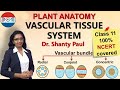
Vascular Bundles and Cambium Functions

Interactive Video
•
Biology, Science
•
9th - 10th Grade
•
Practice Problem
•
Hard

Patricia Brown
FREE Resource
Read more
10 questions
Show all answers
1.
MULTIPLE CHOICE QUESTION
30 sec • 1 pt
What are the three tissue systems mentioned in the introduction?
Xylem, Phloem, and Cambium
Dermal, Conducting, and Fundamental
Radial, Conjoined, and Concentric
Epidermal, Vascular, and Ground
2.
MULTIPLE CHOICE QUESTION
30 sec • 1 pt
In radial vascular bundles, how are xylem and phloem arranged?
Phloem surrounds xylem
Alternating on different radii
On the same radius
Xylem surrounds phloem
3.
MULTIPLE CHOICE QUESTION
30 sec • 1 pt
Which type of vascular bundle is commonly found in roots?
Conjoined
Bicollateral
Radial
Concentric
4.
MULTIPLE CHOICE QUESTION
30 sec • 1 pt
What is a characteristic feature of conjoined collateral vascular bundles in dicot stems?
Phloem surrounds xylem
Xylem surrounds phloem
Absence of cambium
Presence of cambium
5.
MULTIPLE CHOICE QUESTION
30 sec • 1 pt
In which type of plant are bicollateral vascular bundles typically found?
Monocot stems
Gourd plants
Fern rhizomes
Dicot roots
6.
MULTIPLE CHOICE QUESTION
30 sec • 1 pt
What distinguishes open vascular bundles from closed ones?
Absence of cambium
Presence of phloem
Absence of xylem
Presence of cambium
7.
MULTIPLE CHOICE QUESTION
30 sec • 1 pt
What is the main function of cambium in vascular bundles?
Conducting food
Primary growth
Conducting water
Secondary growth
Access all questions and much more by creating a free account
Create resources
Host any resource
Get auto-graded reports

Continue with Google

Continue with Email

Continue with Classlink

Continue with Clever
or continue with

Microsoft
%20(1).png)
Apple

Others
Already have an account?

