
Understanding Inertia and Mass Effects

Interactive Video
•
Physics, Science, Other
•
9th - 10th Grade
•
Practice Problem
•
Hard

Patricia Brown
FREE Resource
Read more
10 questions
Show all answers
1.
MULTIPLE CHOICE QUESTION
30 sec • 1 pt
What does Newton's First Law primarily describe?
The motion of planets
The speed of light
The force of gravity
The concept of inertia
2.
MULTIPLE CHOICE QUESTION
30 sec • 1 pt
Why is it harder to push a 50 kg ball compared to a 5 kg ball in space?
Because it is made of metal
Because it is further away
Because it has more mass
Because it is larger
3.
MULTIPLE CHOICE QUESTION
30 sec • 1 pt
What is inertia?
The tendency of an object to change its color
The resistance to change in motion
The force that stops objects
The ability to move faster
4.
MULTIPLE CHOICE QUESTION
30 sec • 1 pt
How can stationary objects be described in terms of motion?
They are always moving
They have a valid kind of motion
They have no motion
They are invisible
5.
MULTIPLE CHOICE QUESTION
30 sec • 1 pt
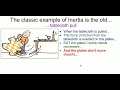
What happens to objects on a table when a tablecloth is pulled quickly?
They change color
They fly off the table
They disappear
They remain stationary due to inertia
6.
MULTIPLE CHOICE QUESTION
30 sec • 1 pt
Why do heavier objects resist motion more than lighter ones?
Because they have more inertia
Because they are larger
Because they are closer to the ground
Because they are made of metal
7.
MULTIPLE CHOICE QUESTION
30 sec • 1 pt
What is the effect of mass on inertia?
More mass means less inertia
Mass has no effect on inertia
Mass decreases inertia
More mass means more inertia
Access all questions and much more by creating a free account
Create resources
Host any resource
Get auto-graded reports

Continue with Google

Continue with Email

Continue with Classlink

Continue with Clever
or continue with

Microsoft
%20(1).png)
Apple

Others
Already have an account?

