
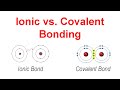
Types of Chemical Bonds

Interactive Video
•
Chemistry, Science, Physics
•
9th - 10th Grade
•
Practice Problem
•
Hard

Patricia Brown
FREE Resource
Read more
10 questions
Show all answers
1.
MULTIPLE CHOICE QUESTION
30 sec • 1 pt
What is a key characteristic of covalent bonds?
Electrons are transferred between elements.
Electrons are shared between elements.
Electrons are lost by both elements.
Electrons are gained by both elements.
2.
MULTIPLE CHOICE QUESTION
30 sec • 1 pt
In ionic bonds, what happens to the electrons?
They remain unchanged.
They are transferred from one element to another.
They are shared equally.
They are lost by both elements.
3.
MULTIPLE CHOICE QUESTION
30 sec • 1 pt
How can you determine if NaCl is ionic or covalent?
By checking if both elements are metals.
By measuring their atomic masses.
By looking at their positions on the periodic table.
By checking if both elements are non-metals.
4.
MULTIPLE CHOICE QUESTION
30 sec • 1 pt
What type of bond is present in NF3?
Hydrogen
Metallic
Covalent
Ionic
5.
MULTIPLE CHOICE QUESTION
30 sec • 1 pt
Which of the following compounds is ionic?
PCl5
Iodine chloride
NF3
Copper sulfide
6.
MULTIPLE CHOICE QUESTION
30 sec • 1 pt
What is the bond type in Iodine chloride (ICl)?
Ionic
Covalent
Metallic
Hydrogen
7.
MULTIPLE CHOICE QUESTION
30 sec • 1 pt
Which elements are involved in covalent bonding?
Elements from the left side of the periodic table
Elements from the right side of the periodic table
One element from the left and one from the right
Transition metals only
Access all questions and much more by creating a free account
Create resources
Host any resource
Get auto-graded reports

Continue with Google

Continue with Email

Continue with Classlink

Continue with Clever
or continue with

Microsoft
%20(1).png)
Apple

Others
Already have an account?

