
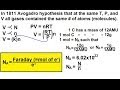
Avogadro's Number and Gas Laws

Interactive Video
•
Physics, Chemistry, Science
•
9th - 12th Grade
•
Practice Problem
•
Hard

Patricia Brown
FREE Resource
Read more
10 questions
Show all answers
1.
MULTIPLE CHOICE QUESTION
30 sec • 1 pt
What is Avogadro's number primarily used to represent?
The number of electrons in an atom
The number of molecules in a mole
The number of protons in a nucleus
The number of atoms in a gram
2.
MULTIPLE CHOICE QUESTION
30 sec • 1 pt
According to Avogadro's hypothesis, what remains constant for all gases at the same temperature, pressure, and volume?
The number of molecules
The number of electrons
The number of neutrons
The number of protons
3.
MULTIPLE CHOICE QUESTION
30 sec • 1 pt
What is the relationship between the volume of a gas and the number of molecules it contains?
Volume is inversely proportional to the number of molecules
Volume is directly proportional to the number of molecules
Volume is unrelated to the number of molecules
Volume is equal to the number of molecules
4.
MULTIPLE CHOICE QUESTION
30 sec • 1 pt
What is the significance of the constant 'k' in the equation relating volume and number of moles?
It is the gas constant
It represents the number of electrons
It is a random constant with no specific meaning
It represents the number of protons
5.
MULTIPLE CHOICE QUESTION
30 sec • 1 pt
How did Faraday contribute to the determination of Avogadro's number?
By measuring the mass of a single atom
By determining the charge of one mole of electrons
By calculating the number of protons in a nucleus
By discovering the electron
6.
MULTIPLE CHOICE QUESTION
30 sec • 1 pt
What was Millikan's contribution to the understanding of Avogadro's number?
He discovered the neutron
He measured the charge of a single electron
He determined the number of atoms in a mole
He calculated the mass of a proton
7.
MULTIPLE CHOICE QUESTION
30 sec • 1 pt
What is the Faraday constant named after?
The number of protons in a nucleus
The charge of one mole of electrons
The mass of a single atom
The number of neutrons in an atom
Access all questions and much more by creating a free account
Create resources
Host any resource
Get auto-graded reports

Continue with Google

Continue with Email

Continue with Microsoft
or continue with

%20(1).png)
Apple

Others
Already have an account?


