
Reaction Rates and Order Concepts

Interactive Video
•
Chemistry, Science, Physics
•
11th - 12th Grade
•
Practice Problem
•
Hard

Patricia Brown
FREE Resource
Read more
10 questions
Show all answers
1.
MULTIPLE CHOICE QUESTION
30 sec • 1 pt
What happens to the reaction rate as the reactants are consumed over time?
It remains constant.
It increases.
It decreases.
It fluctuates randomly.
2.
MULTIPLE CHOICE QUESTION
30 sec • 1 pt
What is the primary purpose of the method of initial rates?
To measure the temperature change during a reaction.
To determine the final products of a reaction.
To find the rate law of a reaction.
To calculate the energy released in a reaction.
3.
MULTIPLE CHOICE QUESTION
30 sec • 1 pt
How is the reaction order determined?
By analyzing the balanced chemical equation.
Through experimental data.
By calculating the energy change.
By measuring the color change.
4.
MULTIPLE CHOICE QUESTION
30 sec • 1 pt
What does a unimolecular reaction depend on?
One molecule undergoing a change.
Three molecules interacting.
Two molecules colliding.
The presence of a catalyst.
5.
MULTIPLE CHOICE QUESTION
30 sec • 1 pt
What does the exponent in the rate law indicate?
The color change during the reaction.
The temperature at which the reaction occurs.
The number of molecules involved in the rate-determining step.
The speed of the reaction.
6.
MULTIPLE CHOICE QUESTION
30 sec • 1 pt
What is the relationship between rate laws and coefficients in a balanced reaction?
They are equal.
They are directly proportional.
They are inversely proportional.
There is no direct relationship.
7.
MULTIPLE CHOICE QUESTION
30 sec • 1 pt
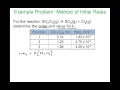
In the example provided, what is the reaction order determined to be?
Zero order
First order
Third order
Second order
Access all questions and much more by creating a free account
Create resources
Host any resource
Get auto-graded reports

Continue with Google

Continue with Email

Continue with Classlink

Continue with Clever
or continue with

Microsoft
%20(1).png)
Apple

Others
Already have an account?

