
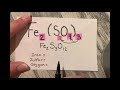
Chemical Formulas and Atom Counting

Interactive Video
•
Chemistry, Mathematics, Science
•
9th - 10th Grade
•
Practice Problem
•
Hard

Patricia Brown
FREE Resource
Read more
10 questions
Show all answers
1.
MULTIPLE CHOICE QUESTION
30 sec • 1 pt
What does a subscript in a chemical formula indicate?
The charge of the element
The number of atoms of an element
The number of molecules
The type of element
2.
MULTIPLE CHOICE QUESTION
30 sec • 1 pt
If there is no subscript next to an element in a chemical formula, what does it imply?
The element is a gas
The element is a metal
There is one atom of the element
The element is not present
3.
MULTIPLE CHOICE QUESTION
30 sec • 1 pt
How does a coefficient affect the number of atoms in a chemical formula?
It reduces the number of atoms
It changes the element type
It multiplies the number of atoms
It adds more elements
4.
MULTIPLE CHOICE QUESTION
30 sec • 1 pt
In the formula 2H2SO4, how many hydrogen atoms are present?
8
6
4
2
5.
MULTIPLE CHOICE QUESTION
30 sec • 1 pt
What is the total number of sulfur atoms in 2H2SO4?
4
1
2
3
6.
MULTIPLE CHOICE QUESTION
30 sec • 1 pt
How many oxygen atoms are there in 2H2SO4?
6
10
4
8
7.
MULTIPLE CHOICE QUESTION
30 sec • 1 pt
What does a subscript outside parentheses in a chemical formula indicate?
It is ignored
It applies to all elements inside the parentheses
It indicates a charge
It applies to the element before it
Access all questions and much more by creating a free account
Create resources
Host any resource
Get auto-graded reports

Continue with Google

Continue with Email

Continue with Classlink

Continue with Clever
or continue with

Microsoft
%20(1).png)
Apple

Others
Already have an account?


