
Homeostasis and Feedback Mechanisms

Interactive Video
•
Biology, Science, Chemistry
•
9th - 10th Grade
•
Practice Problem
•
Hard

Patricia Brown
FREE Resource
Read more
10 questions
Show all answers
1.
MULTIPLE CHOICE QUESTION
30 sec • 1 pt
What is the primary function of homeostasis in organisms?
To maintain a stable internal environment
To increase external fluctuations
To enhance cell division
To eliminate all external changes
2.
MULTIPLE CHOICE QUESTION
30 sec • 1 pt
Which of the following is NOT a part of the homeostatic mechanism template?
Stimulus
Receptors
Hormone
Effector
3.
MULTIPLE CHOICE QUESTION
30 sec • 1 pt
In the context of homeostasis, what role does the control center play?
It acts as a receptor
It directly corrects deviations
It integrates information and signals effectors
It detects environmental changes
4.
MULTIPLE CHOICE QUESTION
30 sec • 1 pt
How does the body respond when the temperature rises above the set point?
By constricting blood vessels
By increasing sweat production
By decreasing heart rate
By reducing metabolic rate
5.
MULTIPLE CHOICE QUESTION
30 sec • 1 pt
What is the set point for normal body temperature in degrees Celsius?
36
38
37
35
6.
MULTIPLE CHOICE QUESTION
30 sec • 1 pt
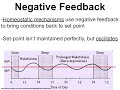
Which feedback mechanism is responsible for amplifying deviations from the set point?
Negative feedback
Cyclic feedback
Positive feedback
Neutral feedback
7.
MULTIPLE CHOICE QUESTION
30 sec • 1 pt
During childbirth, which hormone is primarily involved in the positive feedback loop?
Cortisol
Oxytocin
Insulin
Adrenaline
Access all questions and much more by creating a free account
Create resources
Host any resource
Get auto-graded reports

Continue with Google

Continue with Email

Continue with Classlink

Continue with Clever
or continue with

Microsoft
%20(1).png)
Apple

Others
Already have an account?

