
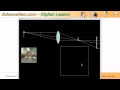
Ray Diagrams and Lens Properties

Interactive Video
•
Physics, Science, Other
•
6th - 8th Grade
•
Practice Problem
•
Hard

Patricia Brown
FREE Resource
Read more
10 questions
Show all answers
1.
MULTIPLE CHOICE QUESTION
30 sec • 1 pt
What is the first step in setting up an experiment for ray diagrams?
Creating a dark optical space
Choosing a lens type
Placing a screen
Selecting an object
2.
MULTIPLE CHOICE QUESTION
30 sec • 1 pt
What happens to the image when an object is placed in front of a convex lens?
It becomes upright and larger
It disappears
It forms an upside-down image
It remains unchanged
3.
MULTIPLE CHOICE QUESTION
30 sec • 1 pt
How can you bring an out-of-focus image back into focus when using a convex lens?
Move the object closer to the lens
Adjust the size of the screen
Change the lens type
Move the screen to the correct position
4.
MULTIPLE CHOICE QUESTION
30 sec • 1 pt
What is the result of moving an object outside twice the focal point of a convex lens?
The image becomes virtual
The image disappears
The image becomes smaller and upside-down
The image becomes larger and upright
5.
MULTIPLE CHOICE QUESTION
30 sec • 1 pt
What type of image does a concave lens form?
Virtual and upside-down
Real and upside-down
Virtual and upright
Real and upright
6.
MULTIPLE CHOICE QUESTION
30 sec • 1 pt
Why can't a virtual image be displayed on a screen?
Because the rays do not converge
Because it is too small
Because it is upside-down
Because it is not in focus
7.
MULTIPLE CHOICE QUESTION
30 sec • 1 pt
What is the purpose of using an eyeball in the concave lens experiment?
To magnify the image
To display the virtual image
To simulate human vision
To focus the rays
Access all questions and much more by creating a free account
Create resources
Host any resource
Get auto-graded reports

Continue with Google

Continue with Email

Continue with Classlink

Continue with Clever
or continue with

Microsoft
%20(1).png)
Apple

Others
Already have an account?

