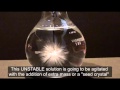
Solubility and Solution Characteristics

Interactive Video
•
Chemistry, Science, Physics
•
9th - 10th Grade
•
Practice Problem
•
Hard

Patricia Brown
FREE Resource
Read more
10 questions
Show all answers
1.
MULTIPLE CHOICE QUESTION
30 sec • 1 pt
What is the main characteristic of a supersaturated solution?
It contains more solute than can be dissolved, leading to precipitation.
It contains no solute.
It contains the maximum amount of solute that can be dissolved.
It contains less solute than can be dissolved.
2.
MULTIPLE CHOICE QUESTION
30 sec • 1 pt
How can you determine if a solution is saturated?
By adding more solvent.
By adding more solute until no more dissolves.
By heating the solution.
By cooling the solution.
3.
MULTIPLE CHOICE QUESTION
30 sec • 1 pt
What does the y-axis represent on a solubility curve?
Pressure of the solution.
Temperature in Celsius.
Grams of solute per 100 grams of water.
Volume of solvent.
4.
MULTIPLE CHOICE QUESTION
30 sec • 1 pt
How does temperature affect the solubility of potassium chloride?
Solubility decreases with decreasing temperature.
Solubility increases with increasing temperature.
Solubility remains constant with temperature changes.
Solubility decreases with increasing temperature.
5.
MULTIPLE CHOICE QUESTION
30 sec • 1 pt
If you have 100 grams of water at 75°C, how many grams of potassium chloride can be dissolved?
90 grams
30 grams
50 grams
70 grams
6.
MULTIPLE CHOICE QUESTION
30 sec • 1 pt
What happens to a supersaturated solution if it is disturbed?
It becomes unsaturated.
It remains supersaturated.
It dissolves completely.
It crystallizes and becomes saturated.
7.
MULTIPLE CHOICE QUESTION
30 sec • 1 pt
How do you calculate the amount of precipitate formed when cooling a solution?
Multiply the solubility at both temperatures.
Divide the solubility at the higher temperature by the solubility at the lower temperature.
Add the solubility at both temperatures.
Subtract the solubility at the lower temperature from the solubility at the higher temperature.
Access all questions and much more by creating a free account
Create resources
Host any resource
Get auto-graded reports

Continue with Google

Continue with Email

Continue with Classlink

Continue with Clever
or continue with

Microsoft
%20(1).png)
Apple

Others
Already have an account?
Similar Resources on Wayground

11 questions
Isotopes and Ions Concepts
Interactive video
•
9th - 10th Grade
11 questions
Methyl Groups in Organic Chemistry
Interactive video
•
9th - 10th Grade
11 questions
Understanding Motion: Forces and Resistance
Interactive video
•
9th - 10th Grade
8 questions
CLEAN : India's desert salt farmers feel the heat from climate change
Interactive video
•
9th - 10th Grade
10 questions
Rubidium Carbonate and Aqueous Reactions
Interactive video
•
9th - 10th Grade
11 questions
Concept 3 - Scale, Proportion, and Quantity
Interactive video
•
9th - 10th Grade
11 questions
Ionic Bonds and Electron Transfer
Interactive video
•
9th - 10th Grade
11 questions
Projectile Motion Concepts and Calculations
Interactive video
•
9th - 10th Grade
Popular Resources on Wayground
7 questions
History of Valentine's Day
Interactive video
•
4th Grade
15 questions
Fractions on a Number Line

Quiz
•
3rd Grade
20 questions
Equivalent Fractions
Quiz
•
3rd Grade
25 questions
Multiplication Facts
Quiz
•
5th Grade
22 questions
fractions
Quiz
•
3rd Grade
15 questions
Valentine's Day Trivia
Quiz
•
3rd Grade
20 questions
Main Idea and Details
Quiz
•
5th Grade
20 questions
Context Clues
Quiz
•
6th Grade
Discover more resources for Chemistry
25 questions
Unit 8 Stoichiometry Review
Quiz
•
10th Grade
20 questions
Types of Chemical Reactions
Quiz
•
9th - 12th Grade
19 questions
Stoichiometry, Limiting Reactants, and Percent Yield
Quiz
•
10th Grade
10 questions
Formative 3BD: Ionic Bonds
Quiz
•
9th Grade
15 questions
Balancing Chemical Equations
Quiz
•
10th - 12th Grade
20 questions
Naming & Writing Chemical Formulas
Quiz
•
10th Grade
10 questions
Identifying types of reactions
Quiz
•
9th - 12th Grade
20 questions
Periodic Trends
Quiz
•
10th Grade