
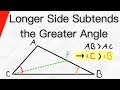
Triangle Angle-Side Relationships

Interactive Video
•
Mathematics
•
9th - 10th Grade
•
Practice Problem
•
Hard

Patricia Brown
FREE Resource
Read more
10 questions
Show all answers
1.
MULTIPLE CHOICE QUESTION
30 sec • 1 pt
What is the main idea introduced about triangles in the beginning of the lesson?
The longest side is always opposite the largest angle.
All sides of a triangle are equal.
The shortest side is always opposite the smallest angle.
A longer side in a triangle is opposite a larger angle.
2.
MULTIPLE CHOICE QUESTION
30 sec • 1 pt
What is the first step in setting up the proof for the triangle angle-side relationship?
Drawing a perpendicular bisector.
Creating an isosceles triangle by marking a point on the longer side.
Measuring all angles of the triangle.
Assuming all sides are equal.
3.
MULTIPLE CHOICE QUESTION
30 sec • 1 pt
What is the significance of point P in the proof setup?
It is the endpoint of side AC.
It is a point on AB such that AP equals AC.
It is the midpoint of side AB.
It is the center of the triangle.
4.
MULTIPLE CHOICE QUESTION
30 sec • 1 pt
How does the isosceles triangle theorem help in the proof?
It shows that all angles in a triangle are equal.
It proves that the longest side is opposite the largest angle.
It establishes that angles opposite equal sides are congruent.
It demonstrates that the sum of angles in a triangle is 180 degrees.
5.
MULTIPLE CHOICE QUESTION
30 sec • 1 pt
Why is the isosceles triangle theorem important in this proof?
It proves that the triangle is equilateral.
It helps in calculating the area of the triangle.
It allows us to conclude that two angles are congruent.
It shows that the triangle is right-angled.
6.
MULTIPLE CHOICE QUESTION
30 sec • 1 pt
What theorem is used to relate angle APC to angle B?
Congruent Angles Theorem
Pythagorean Theorem
Angle Sum Theorem
Exterior Angle Theorem
7.
MULTIPLE CHOICE QUESTION
30 sec • 1 pt
What does the exterior angle theorem state in the context of this proof?
An exterior angle is always larger than the adjacent interior angle.
An exterior angle is equal to one of the interior angles.
An exterior angle is always smaller than any interior angle.
An exterior angle is equal to the sum of the opposite interior angles.
Access all questions and much more by creating a free account
Create resources
Host any resource
Get auto-graded reports

Continue with Google

Continue with Email

Continue with Classlink

Continue with Clever
or continue with

Microsoft
%20(1).png)
Apple

Others
Already have an account?

