
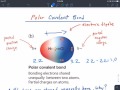
Polar and Non-Polar Bonds

Interactive Video
•
Chemistry, Science, Biology
•
9th - 10th Grade
•
Practice Problem
•
Hard

Patricia Brown
FREE Resource
Read more
10 questions
Show all answers
1.
MULTIPLE CHOICE QUESTION
30 sec • 1 pt
What is the primary characteristic of an ionic bond?
Equal sharing of electrons
Transfer of electrons
No electron movement
Formation of a dipole
2.
MULTIPLE CHOICE QUESTION
30 sec • 1 pt
Which type of bond involves the sharing of electrons?
Hydrogen bond
Metallic bond
Covalent bond
Ionic bond
3.
MULTIPLE CHOICE QUESTION
30 sec • 1 pt
What is the range of electronegativity difference for a non-polar covalent bond?
1.1 to 1.5
1.6 to 2.0
0.5 to 1.0
0 to 0.4
4.
MULTIPLE CHOICE QUESTION
30 sec • 1 pt
In a non-polar covalent bond, how are electrons shared?
Not shared
Unequally
Transferred
Equally
5.
MULTIPLE CHOICE QUESTION
30 sec • 1 pt
What causes the partial charges in a polar covalent bond?
Equal sharing of electrons
Unequal sharing of electrons
No electron movement
Transfer of electrons
6.
MULTIPLE CHOICE QUESTION
30 sec • 1 pt
Which atom in a polar covalent bond tends to have a partial negative charge?
The atom with higher electronegativity
The atom with fewer electrons
The atom with more protons
The atom with lower electronegativity
7.
MULTIPLE CHOICE QUESTION
30 sec • 1 pt
Which bond is more polar: a polar covalent bond or an ionic bond?
Neither is polar
Both are equally polar
Ionic bond
Polar covalent bond
Access all questions and much more by creating a free account
Create resources
Host any resource
Get auto-graded reports

Continue with Google

Continue with Email

Continue with Classlink

Continue with Clever
or continue with

Microsoft
%20(1).png)
Apple

Others
Already have an account?

