
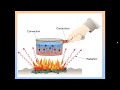
Heat Transfer and Energy Concepts

Interactive Video
•
Physics, Science, Geography
•
9th - 12th Grade
•
Practice Problem
•
Hard

Patricia Brown
FREE Resource
Read more
10 questions
Show all answers
1.
MULTIPLE CHOICE QUESTION
30 sec • 1 pt
What is the primary difference between kinetic and potential energy?
Kinetic energy is energy in motion, while potential energy is stored energy.
Kinetic energy is stored energy, while potential energy is energy in motion.
Kinetic energy is only found in gases, while potential energy is found in solids.
Kinetic energy is related to temperature, while potential energy is not.
2.
MULTIPLE CHOICE QUESTION
30 sec • 1 pt
How is temperature scientifically defined?
As the potential energy of a system.
As the measure of the average kinetic energy of air molecules.
As the difference between hot and cold air.
As the amount of heat in a substance.
3.
MULTIPLE CHOICE QUESTION
30 sec • 1 pt
What does specific heat refer to?
The energy required to change the state of water.
The energy needed to raise the temperature of a unit mass by one degree.
The energy needed to cool a substance by one degree.
The energy required to change the temperature of a substance without a phase change.
4.
MULTIPLE CHOICE QUESTION
30 sec • 1 pt
Which type of heat is involved in changing the state of water?
Sensible heat
Specific heat
Latent heat
Conduction heat
5.
MULTIPLE CHOICE QUESTION
30 sec • 1 pt
What is conduction?
The transfer of heat by changing the state of a substance.
The transfer of heat through matter by molecular motion.
The transfer of heat by mass motion or circulation.
The transfer of heat through electromagnetic waves.
6.
MULTIPLE CHOICE QUESTION
30 sec • 1 pt
Which method of heat transfer involves the movement of fluids?
Latent heat
Radiation
Convection
Conduction
7.
MULTIPLE CHOICE QUESTION
30 sec • 1 pt
How does the Earth primarily receive energy from the Sun?
Through latent heat
Through conduction
Through convection
Through radiation
Access all questions and much more by creating a free account
Create resources
Host any resource
Get auto-graded reports

Continue with Google

Continue with Email

Continue with Classlink

Continue with Clever
or continue with

Microsoft
%20(1).png)
Apple

Others
Already have an account?


