
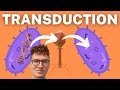
Bacterial Recombination and Transduction

Interactive Video
•
Biology, Science, Chemistry
•
9th - 12th Grade
•
Practice Problem
•
Hard

Patricia Brown
FREE Resource
Read more
10 questions
Show all answers
1.
MULTIPLE CHOICE QUESTION
30 sec • 1 pt
What is a potential benefit for bacteria that undergo recombination?
Loss of genetic material
Decreased lifespan
Antibiotic resistance
Increased size
2.
MULTIPLE CHOICE QUESTION
30 sec • 1 pt
Which of the following is NOT a method of bacterial recombination?
Transformation
Replication
Conjugation
Transduction
3.
MULTIPLE CHOICE QUESTION
30 sec • 1 pt
How is DNA transferred between bacteria during transduction?
Through direct contact
Via a virus
By absorbing DNA from the environment
Through a pilus
4.
MULTIPLE CHOICE QUESTION
30 sec • 1 pt
What is the role of viruses in the lytic pathway?
They remain dormant
They cause the host cell to burst
They help the host cell to grow
They integrate into the host genome
5.
MULTIPLE CHOICE QUESTION
30 sec • 1 pt
What does the term 'obligate parasites' refer to in the context of viruses?
Viruses that do not cause disease
Viruses that can switch between hosts
Viruses that require a host to complete their life cycle
Viruses that can replicate independently
6.
MULTIPLE CHOICE QUESTION
30 sec • 1 pt
In generalized transduction, what part of the host's DNA can bacteriophages transfer?
Only specific genes
Any portion of the DNA
Only plasmids
Only the entire genome
7.
MULTIPLE CHOICE QUESTION
30 sec • 1 pt
What distinguishes specialized transduction from generalized transduction?
It transfers specific DNA segments
It occurs without a host
It does not involve viruses
It transfers any DNA
Access all questions and much more by creating a free account
Create resources
Host any resource
Get auto-graded reports

Continue with Google

Continue with Email

Continue with Microsoft
or continue with

%20(1).png)
Apple

Others
By signing up, you agree to our Terms of Service & Privacy Policy
Already have an account?

