
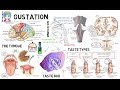
Cranial Nerves and Taste Sensation

Interactive Video
•
Biology, Science, Chemistry
•
9th - 10th Grade
•
Practice Problem
•
Hard

Patricia Brown
FREE Resource
Read more
10 questions
Show all answers
1.
MULTIPLE CHOICE QUESTION
30 sec • 1 pt
Where is the primary gustatory cortex located?
Near the face representation within the postcentral gyrus
In the occipital lobe
In the cerebellum
Near the auditory cortex
2.
MULTIPLE CHOICE QUESTION
30 sec • 1 pt
What are the three types of papillae on the tongue that contain taste buds?
Filiform, fungiform, and foliate
Circumvallate, filiform, and fungiform
Fungiform, foliate, and circumvallate
Foliate, filiform, and circumvallate
3.
MULTIPLE CHOICE QUESTION
30 sec • 1 pt
Which ion is primarily responsible for the taste of salt?
Chloride
Sodium
Calcium
Potassium
4.
MULTIPLE CHOICE QUESTION
30 sec • 1 pt
How is sour taste detected by the taste buds?
Through calcium channels
By direct interaction with potassium channels
By binding to G protein-coupled receptors
Through sodium channels or proton transport membrane proteins
5.
MULTIPLE CHOICE QUESTION
30 sec • 1 pt
What is the role of cyclic AMP in sweet taste transduction?
It activates proton transport
It increases sodium influx
It reduces potassium outflow
It opens calcium channels
6.
MULTIPLE CHOICE QUESTION
30 sec • 1 pt
Which cranial nerve innervates the anterior two-thirds of the tongue?
Cranial nerve IX
Cranial nerve X
Cranial nerve VII
Cranial nerve V
7.
MULTIPLE CHOICE QUESTION
30 sec • 1 pt
Which cranial nerve is responsible for taste sensation in the posterior one-third of the tongue?
Cranial nerve V
Cranial nerve VII
Cranial nerve IX
Cranial nerve X
Access all questions and much more by creating a free account
Create resources
Host any resource
Get auto-graded reports

Continue with Google

Continue with Email

Continue with Classlink

Continue with Clever
or continue with

Microsoft
%20(1).png)
Apple

Others
Already have an account?

