
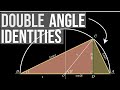
Double Angle Identities in Proofs

Interactive Video
•
Mathematics, Physics, Science
•
9th - 12th Grade
•
Practice Problem
•
Hard

Patricia Brown
FREE Resource
Read more
10 questions
Show all answers
1.
MULTIPLE CHOICE QUESTION
30 sec • 1 pt
What is the initial setup for the semicircle proof?
A full circle with radius one and points O and B
A semicircle with radius two and points O and A
A semicircle with radius one and points O and A
A semicircle with radius three and points O and C
2.
MULTIPLE CHOICE QUESTION
30 sec • 1 pt
What is the relationship between the angle 2T and the triangle ODC?
2T is the angle adjacent to the hypotenuse in triangle ODC
2T is the angle opposite to the hypotenuse in triangle ODC
2T is the hypotenuse of triangle ODC
2T is the angle at point D in triangle ODC
3.
MULTIPLE CHOICE QUESTION
30 sec • 1 pt
How is the angle B in triangle ACB related to angle 2T?
Angle B is equal to 2T
Angle B is supplementary to 2T
Angle B is half of 2T
Angle B is twice 2T
4.
MULTIPLE CHOICE QUESTION
30 sec • 1 pt
What is the length of the hypotenuse in triangle ACB?
One
Two
Four
Three
5.
MULTIPLE CHOICE QUESTION
30 sec • 1 pt
What is the significance of the similarity between the two triangles in the proof?
It proves that the triangles are isosceles
It helps in deriving the double angle identities
It indicates that the triangles have equal perimeters
It shows that the triangles are congruent
6.
MULTIPLE CHOICE QUESTION
30 sec • 1 pt
What is the double angle identity for sine derived in the proof?
sin(2T) = sin(T) * cos(T)
sin(2T) = 2 * sin(T) * cos(T)
sin(2T) = cos(T) * sin(T)
sin(2T) = 2 * cos(T) * sin(T)
7.
MULTIPLE CHOICE QUESTION
30 sec • 1 pt
What is the double angle identity for cosine derived in the proof?
cos(2T) = 2 * cos^2(T) - 1
cos(2T) = cos^2(T) - sin^2(T)
cos(2T) = 1 - 2 * sin^2(T)
cos(2T) = 2 * sin^2(T) - 1
Access all questions and much more by creating a free account
Create resources
Host any resource
Get auto-graded reports

Continue with Google

Continue with Email

Continue with Microsoft
or continue with

%20(1).png)
Apple

Others
By signing up, you agree to our Terms of Service & Privacy Policy
Already have an account?


