
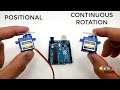
Controlling Servo Motors with Arduino

Interactive Video
•
Science, Computers, Physics
•
9th - 10th Grade
•
Practice Problem
•
Hard

Patricia Brown
FREE Resource
Read more
10 questions
Show all answers
1.
MULTIPLE CHOICE QUESTION
30 sec • 1 pt
What is the main difference between positional and continuous rotation servo motors?
Positional servos rotate to a specific angle, while continuous rotation servos rotate continuously.
Continuous rotation servos have no wires.
Continuous rotation servos can rotate to a specific angle.
Positional servos can rotate 360 degrees.
2.
MULTIPLE CHOICE QUESTION
30 sec • 1 pt
How many connections does a positional servo motor have?
Four
Two
Five
Three
3.
MULTIPLE CHOICE QUESTION
30 sec • 1 pt
What is the typical range of motion for a positional servo motor?
90 degrees
270 degrees
180 degrees
360 degrees
4.
MULTIPLE CHOICE QUESTION
30 sec • 1 pt
What happens when you send a value of 90 to a continuous rotation servo motor?
It rotates at full speed counterclockwise.
It rotates at full speed clockwise.
It stops rotating.
It rotates to 90 degrees.
5.
MULTIPLE CHOICE QUESTION
30 sec • 1 pt
What does the control signal from the Arduino determine for a continuous rotation servo motor?
The type of motor
The angle of rotation
The speed of rotation
The color of the wires
6.
MULTIPLE CHOICE QUESTION
30 sec • 1 pt
How is a potentiometer used with a servo motor?
To control the motor's speed
To change the motor's color
To map analog input to servo position
To adjust the motor's voltage
7.
MULTIPLE CHOICE QUESTION
30 sec • 1 pt
What is the range of values for the analog input when using a potentiometer with Arduino?
0 to 2048
0 to 1023
0 to 512
0 to 255
Access all questions and much more by creating a free account
Create resources
Host any resource
Get auto-graded reports

Continue with Google

Continue with Email

Continue with Classlink

Continue with Clever
or continue with

Microsoft
%20(1).png)
Apple

Others
Already have an account?

