
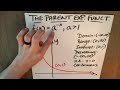
Exponential Decay Function Concepts

Interactive Video
•
Mathematics
•
9th - 10th Grade
•
Practice Problem
•
Hard

Patricia Brown
FREE Resource
Read more
10 questions
Show all answers
1.
MULTIPLE CHOICE QUESTION
30 sec • 1 pt
What is the domain of the parent exponential function f(x) = a^x?
All negative numbers
All positive numbers
All real numbers
Only integers
2.
MULTIPLE CHOICE QUESTION
30 sec • 1 pt
Which of the following is true about the range of the parent exponential function?
It is limited to positive integers
It includes negative numbers
It starts from zero but does not include it
It includes zero
3.
MULTIPLE CHOICE QUESTION
30 sec • 1 pt
What is the y-intercept of the parent exponential function?
(1, 0)
(0, 0)
(1, 1)
(0, 1)
4.
MULTIPLE CHOICE QUESTION
30 sec • 1 pt
Why does the parent exponential function not have an x-intercept?
Because it has a horizontal asymptote at y = 0
Because it is a linear function
Because it is a decreasing function
Because it is not defined for x = 0
5.
MULTIPLE CHOICE QUESTION
30 sec • 1 pt
What happens to the function f(x) = a^x as x increases?
It decreases
It remains constant
It increases
It oscillates
6.
MULTIPLE CHOICE QUESTION
30 sec • 1 pt
What is the base condition for the function f(x) = a^(-x) to indicate exponential decay?
a < 1
a = 1
a > 1
a = 0
7.
MULTIPLE CHOICE QUESTION
30 sec • 1 pt
How can the base of the function f(x) = a^(-x) be transformed to indicate decay?
By making it a fraction between 0 and 1
By making it a negative number
By making it greater than 1
By making it equal to 1
Access all questions and much more by creating a free account
Create resources
Host any resource
Get auto-graded reports

Continue with Google

Continue with Email

Continue with Microsoft
or continue with

%20(1).png)
Apple

Others
By signing up, you agree to our Terms of Service & Privacy Policy
Already have an account?

