
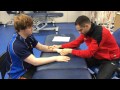
Wrist Assessment and Special Tests

Interactive Video
•
Physical Ed, Science, Other
•
9th - 12th Grade
•
Practice Problem
•
Hard

Patricia Brown
FREE Resource
Read more
10 questions
Show all answers
1.
MULTIPLE CHOICE QUESTION
30 sec • 1 pt
What is the first step in assessing the wrist and hand?
Observing for deformities and swelling
Palpating the wrist extensors
Conducting special tests
Performing resisted tests
2.
MULTIPLE CHOICE QUESTION
30 sec • 1 pt
Which structure is NOT typically palpated during the wrist assessment?
Scaphoid
Wrist extensors
Femur
Radial ligaments
3.
MULTIPLE CHOICE QUESTION
30 sec • 1 pt
What is the purpose of active tests for wrist movements?
To assess ligament integrity
To observe range of motion and pain
To evaluate bone density
To measure muscle strength
4.
MULTIPLE CHOICE QUESTION
30 sec • 1 pt
During passive tests, what should be fixed to ensure accurate assessment?
The elbow
The shoulder
The fingers
The radius and ulna
5.
MULTIPLE CHOICE QUESTION
30 sec • 1 pt
Which movement is NOT part of the active wrist tests?
Flexion
Pronation
Abduction
Extension
6.
MULTIPLE CHOICE QUESTION
30 sec • 1 pt
What is a key consideration when performing resisted tests for wrist movements?
Ensuring the patient uses their shoulder
Using maximum resistance
Avoiding any movement of the elbow
Focusing on finger extension
7.
MULTIPLE CHOICE QUESTION
30 sec • 1 pt
What should be avoided during resisted radial deviation tests?
Using shoulder rotation
Applying resistance to the fingers
Keeping the elbow still
Fixing the radius
Access all questions and much more by creating a free account
Create resources
Host any resource
Get auto-graded reports

Continue with Google

Continue with Email

Continue with Classlink

Continue with Clever
or continue with

Microsoft
%20(1).png)
Apple

Others
Already have an account?

