
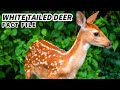
Understanding White-Tailed Deer Behavior

Interactive Video
•
Biology, Science, Geography
•
6th - 8th Grade
•
Practice Problem
•
Hard

Patricia Brown
FREE Resource
Read more
10 questions
Show all answers
1.
MULTIPLE CHOICE QUESTION
30 sec • 1 pt
What is a distinguishing feature of male white-tailed deer?
They have larger ears.
They have antlers.
They have a longer tail.
They are smaller than females.
2.
MULTIPLE CHOICE QUESTION
30 sec • 1 pt
Why are white-tailed deer not found on the west coast of North America?
The climate is too cold.
They are hunted extensively there.
The vegetation is too sparse.
There is too much competition from other deer species.
3.
MULTIPLE CHOICE QUESTION
30 sec • 1 pt
What type of habitat do white-tailed deer prefer?
Mountainous regions
Deserts
Open forests and edge habitats
Urban areas
4.
MULTIPLE CHOICE QUESTION
30 sec • 1 pt
What is a primary component of the white-tailed deer's diet?
Plant parts like flowers and fruits
Small mammals
Fish
Insects
5.
MULTIPLE CHOICE QUESTION
30 sec • 1 pt
How do white-tailed deer digest their food?
They have a single stomach like humans.
They chew cud like cows.
They swallow food whole.
They use their teeth to grind food completely.
6.
MULTIPLE CHOICE QUESTION
30 sec • 1 pt
What has caused the white-tailed deer population to increase significantly?
Introduction of new food sources
Lack of natural predators
Migration to new areas
Increased birth rates
7.
MULTIPLE CHOICE QUESTION
30 sec • 1 pt
What is the term for the period when bucks compete for mating rights?
The rut
Antler clash
Breeding season
Mating call
Access all questions and much more by creating a free account
Create resources
Host any resource
Get auto-graded reports

Continue with Google

Continue with Email

Continue with Classlink

Continue with Clever
or continue with

Microsoft
%20(1).png)
Apple

Others
Already have an account?

