
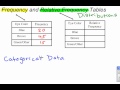
Eye Color Frequency and Relative Frequency

Interactive Video
•
Mathematics, Science, Other
•
6th - 8th Grade
•
Practice Problem
•
Hard

Patricia Brown
FREE Resource
Read more
10 questions
Show all answers
1.
MULTIPLE CHOICE QUESTION
30 sec • 1 pt
What is the main difference between frequency and relative frequency tables?
Frequency tables are for numerical data, while relative frequency tables are for categorical data.
Frequency tables use percentages, while relative frequency tables use counts.
Frequency tables are more accurate than relative frequency tables.
Frequency tables use counts, while relative frequency tables use percentages.
2.
MULTIPLE CHOICE QUESTION
30 sec • 1 pt
What type of data is used to create frequency tables?
Both numerical and categorical data
Numerical data
Only qualitative data
Categorical data
3.
MULTIPLE CHOICE QUESTION
30 sec • 1 pt
In the example provided, which eye color had the highest frequency?
Brown
Other
Green
Blue
4.
MULTIPLE CHOICE QUESTION
30 sec • 1 pt
How do you convert a frequency into a relative frequency?
Divide the frequency by the total number of observations
Add the frequency to the total number of observations
Subtract the frequency from the total number of observations
Multiply the frequency by 100
5.
MULTIPLE CHOICE QUESTION
30 sec • 1 pt
What is the relative frequency of blue eyes in the example?
0.18 or 18%
0.25 or 25%
0.56 or 56%
0.75 or 75%
6.
MULTIPLE CHOICE QUESTION
30 sec • 1 pt
What is the total number of observations in the eye color example?
100
45
80
65
7.
MULTIPLE CHOICE QUESTION
30 sec • 1 pt
Which of the following is a correct relative frequency for brown eyes?
0.56 or 56%
0.75 or 75%
0.25 or 25%
0.18 or 18%
Access all questions and much more by creating a free account
Create resources
Host any resource
Get auto-graded reports

Continue with Google

Continue with Email

Continue with Classlink

Continue with Clever
or continue with

Microsoft
%20(1).png)
Apple

Others
Already have an account?

