
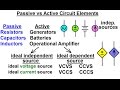
Independent and Dependent Circuit Sources

Interactive Video
•
Physics, Science, Other
•
9th - 12th Grade
•
Practice Problem
•
Hard

Patricia Brown
FREE Resource
Read more
10 questions
Show all answers
1.
MULTIPLE CHOICE QUESTION
30 sec • 1 pt
What is the primary difference between passive and active circuit elements?
Both passive and active elements can generate energy.
Neither passive nor active elements can generate energy.
Active elements can generate energy, while passive elements cannot.
Passive elements can generate energy, while active elements cannot.
2.
MULTIPLE CHOICE QUESTION
30 sec • 1 pt
Which of the following is NOT a passive circuit element?
Battery
Inductor
Capacitor
Resistor
3.
MULTIPLE CHOICE QUESTION
30 sec • 1 pt
Which of these is an example of an active circuit element?
Resistor
Inductor
Capacitor
Generator
4.
MULTIPLE CHOICE QUESTION
30 sec • 1 pt
What is an independent source in a circuit?
A source that cannot provide a constant voltage.
A source that depends on another source for its operation.
A source that only works with passive elements.
A source that operates independently of other sources.
5.
MULTIPLE CHOICE QUESTION
30 sec • 1 pt
Which symbol is used to represent a completely independent source?
A triangle
A square
A circle
A diamond
6.
MULTIPLE CHOICE QUESTION
30 sec • 1 pt
What happens to the voltage across the terminals of some sources when too much current is drawn?
The voltage decreases
The voltage becomes zero
The voltage remains constant
The voltage increases
7.
MULTIPLE CHOICE QUESTION
30 sec • 1 pt
Which of the following is a characteristic of an ideal independent source?
It cannot maintain a constant potential difference.
It can provide unlimited current regardless of the circuit demand.
It can only provide a fixed amount of current.
It depends on another source for its operation.
Access all questions and much more by creating a free account
Create resources
Host any resource
Get auto-graded reports

Continue with Google

Continue with Email

Continue with Classlink

Continue with Clever
or continue with

Microsoft
%20(1).png)
Apple

Others
Already have an account?

