
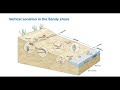
Organisms in Sandy and Muddy Shores

Interactive Video
•
Biology, Science, Geography
•
9th - 10th Grade
•
Practice Problem
•
Hard

Patricia Brown
FREE Resource
Read more
10 questions
Show all answers
1.
MULTIPLE CHOICE QUESTION
30 sec • 1 pt
What type of organisms are typically found in the low tide areas of the rocky intertidal zone?
Sessile organisms
Hard-shelled organisms
Microscopic plants
Soft-shelled organisms
2.
MULTIPLE CHOICE QUESTION
30 sec • 1 pt
Why are sandy shores considered challenging environments for organisms?
They are nutrient-poor and conditions change rapidly
They have stable conditions
They are nutrient-rich
They are always submerged
3.
MULTIPLE CHOICE QUESTION
30 sec • 1 pt
What is a key difference between coarse and fine sandy beaches?
Coarse beaches have more water retention
Fine beaches have more water retention
Fine beaches are nutrient-poor
Coarse beaches are nutrient-rich
4.
MULTIPLE CHOICE QUESTION
30 sec • 1 pt
Which organisms are likely to be found in fine sandy beaches?
Microscopic plants
Sessile organisms
Hard-shelled organisms
Sand dollars and ghost crabs
5.
MULTIPLE CHOICE QUESTION
30 sec • 1 pt
How do organisms in sandy shores protect themselves from predators?
By using camouflage
By staying on the surface
By burrowing deeply
By forming permanent tubes
6.
MULTIPLE CHOICE QUESTION
30 sec • 1 pt
What is a common adaptation of organisms in muddy shores?
High affinity for oxygen
Low affinity for oxygen
Ability to fly
Ability to photosynthesize
7.
MULTIPLE CHOICE QUESTION
30 sec • 1 pt
What is the primary food source for organisms in muddy shores?
Terrestrial plants
Birds
Phytoplankton and benthic algae
Large fish
Access all questions and much more by creating a free account
Create resources
Host any resource
Get auto-graded reports

Continue with Google

Continue with Email

Continue with Microsoft
or continue with

%20(1).png)
Apple

Others
By signing up, you agree to our Terms of Service & Privacy Policy
Already have an account?


