
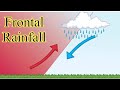
Understanding Weather Fronts and Air Masses

Interactive Video
•
Geography, Science, Other
•
9th - 10th Grade
•
Practice Problem
•
Hard

Patricia Brown
FREE Resource
Read more
10 questions
Show all answers
1.
MULTIPLE CHOICE QUESTION
30 sec • 1 pt
What is the primary characteristic of frontal rainfall?
It is a type of orographic rainfall.
It is caused by convection currents.
It happens along a front.
It occurs in tropical regions.
2.
MULTIPLE CHOICE QUESTION
30 sec • 1 pt
Which regions are most likely to experience frontal rainfall?
Equatorial regions
Mid-latitude regions
Desert regions
High-altitude regions
3.
MULTIPLE CHOICE QUESTION
30 sec • 1 pt
What defines an air mass?
A body of air with low pressure
A body of air with varying temperature and moisture
A body of air with uniform temperature, density, and moisture
A body of air with high pressure
4.
MULTIPLE CHOICE QUESTION
30 sec • 1 pt
What is a front in meteorological terms?
A high-pressure system
An imaginary line where two air masses meet
A type of cloud formation
A low-pressure system
5.
MULTIPLE CHOICE QUESTION
30 sec • 1 pt
What is the process of front formation called?
Frontogenesis
Frontolysis
Cyclogenesis
Anticyclogenesis
6.
MULTIPLE CHOICE QUESTION
30 sec • 1 pt
How does a warm front differ from a cold front?
A warm front is associated with high pressure.
A warm front moves faster than a cold front.
A warm front moves slower than a cold front.
A warm front is associated with low pressure.
7.
MULTIPLE CHOICE QUESTION
30 sec • 1 pt
What type of slope is associated with a warm front?
Steep slope
Gentle slope
No slope
Variable slope
Access all questions and much more by creating a free account
Create resources
Host any resource
Get auto-graded reports

Continue with Google

Continue with Email

Continue with Classlink

Continue with Clever
or continue with

Microsoft
%20(1).png)
Apple

Others
Already have an account?

