
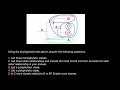
Monophyletic, Paraphyletic, and Polyphyletic Groups

Interactive Video
•
Biology, Science, Other
•
9th - 10th Grade
•
Practice Problem
•
Hard

Patricia Brown
FREE Resource
Read more
10 questions
Show all answers
1.
MULTIPLE CHOICE QUESTION
30 sec • 1 pt
What defines a monophyletic clade?
A group with a single common ancestor and all its descendants.
A group with no common ancestors.
A group with multiple common ancestors.
A group with only one descendant.
2.
MULTIPLE CHOICE QUESTION
30 sec • 1 pt
What is the key characteristic of a monophyletic group?
It includes all descendants of a single common ancestor.
It includes species with multiple ancestors.
It includes only one descendant.
It includes species with no common ancestor.
3.
MULTIPLE CHOICE QUESTION
30 sec • 1 pt
Which of the following is a sister relationship?
Species G and H with multiple ancestors.
Species E and F with no common ancestor.
Species C and D with a recent common ancestor.
Species A and B with a distant ancestor.
4.
MULTIPLE CHOICE QUESTION
30 sec • 1 pt
In a phylogenetic tree, what does a sister group represent?
Two groups with no descendants.
Two groups with different ancestors.
Two groups with a shared recent common ancestor.
Two groups with no common ancestor.
5.
MULTIPLE CHOICE QUESTION
30 sec • 1 pt
What is a paraphyletic clade?
A group with all descendants of a common ancestor.
A group with unrelated species.
A group with some but not all descendants of a common ancestor.
A group with no descendants.
6.
MULTIPLE CHOICE QUESTION
30 sec • 1 pt
What distinguishes a paraphyletic group from a monophyletic group?
A paraphyletic group includes all descendants.
A paraphyletic group includes unrelated species.
A paraphyletic group has no common ancestor.
A paraphyletic group includes only some descendants.
7.
MULTIPLE CHOICE QUESTION
30 sec • 1 pt
Which of the following is an example of a polyphyletic clade?
Species with a single ancestor.
Species that share a recent common ancestor.
Species grouped by similar traits but not closely related.
Species with no common traits.
Access all questions and much more by creating a free account
Create resources
Host any resource
Get auto-graded reports

Continue with Google

Continue with Email

Continue with Classlink

Continue with Clever
or continue with

Microsoft
%20(1).png)
Apple

Others
Already have an account?

