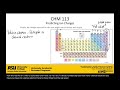
Periodic Table and Ionic Charges

Interactive Video
•
Chemistry, Science, Biology
•
9th - 10th Grade
•
Practice Problem
•
Hard

Patricia Brown
FREE Resource
Read more
10 questions
Show all answers
1.
MULTIPLE CHOICE QUESTION
30 sec • 1 pt
What are the electrons in the outermost shell of an atom called?
Nuclear electrons
Valence electrons
Bonding electrons
Core electrons
2.
MULTIPLE CHOICE QUESTION
30 sec • 1 pt
Why do noble gases tend not to form bonds?
They have incomplete inner shells.
They are highly reactive.
They have no electrons.
They have a full octet of valence electrons.
3.
MULTIPLE CHOICE QUESTION
30 sec • 1 pt
What does the number in a periodic table column indicate?
The number of protons in the nucleus
The atomic mass of the element
The number of neutrons in the nucleus
The number of valence electrons
4.
MULTIPLE CHOICE QUESTION
30 sec • 1 pt
How do elements in the first column of the periodic table typically achieve a full octet?
By gaining one electron
By losing seven electrons
By gaining seven electrons
By losing one electron
5.
MULTIPLE CHOICE QUESTION
30 sec • 1 pt
What charge do elements in the second column of the periodic table typically form?
Minus two
Plus one
Plus two
Minus one
6.
MULTIPLE CHOICE QUESTION
30 sec • 1 pt
What is the typical charge for elements in the third column of the periodic table?
Minus one
Plus one
Minus three
Plus three
7.
MULTIPLE CHOICE QUESTION
30 sec • 1 pt
Why do elements in the fourth column of the periodic table rarely form ions?
They have a full octet naturally.
They are too heavy to form ions.
They prefer to form covalent bonds.
They have no valence electrons.
Access all questions and much more by creating a free account
Create resources
Host any resource
Get auto-graded reports

Continue with Google

Continue with Email

Continue with Classlink

Continue with Clever
or continue with

Microsoft
%20(1).png)
Apple

Others
Already have an account?
Similar Resources on Wayground

6 questions
Molecular Weight and Atomic Structure
Interactive video
•
9th - 10th Grade
11 questions
Understanding Acetone's Structure and Properties
Interactive video
•
9th - 10th Grade
8 questions
Compounds of Alkali Metals
Interactive video
•
9th - 10th Grade
8 questions
Polyatomic Ions and Cadmium Compounds
Interactive video
•
9th - 10th Grade
8 questions
Aluminum and Sulfite Compounds
Interactive video
•
9th - 10th Grade
7 questions
Oxygen Gas and Electrolytes Concepts
Interactive video
•
9th - 10th Grade
6 questions
Molecular Weight Calculations in Chemistry
Interactive video
•
9th - 10th Grade
6 questions
C2H4 Non-Polarity and Structure
Interactive video
•
9th - 10th Grade
Popular Resources on Wayground
7 questions
History of Valentine's Day
Interactive video
•
4th Grade
15 questions
Fractions on a Number Line

Quiz
•
3rd Grade
20 questions
Equivalent Fractions
Quiz
•
3rd Grade
25 questions
Multiplication Facts
Quiz
•
5th Grade
22 questions
fractions
Quiz
•
3rd Grade
15 questions
Valentine's Day Trivia
Quiz
•
3rd Grade
20 questions
Main Idea and Details
Quiz
•
5th Grade
20 questions
Context Clues
Quiz
•
6th Grade
Discover more resources for Chemistry
25 questions
Unit 8 Stoichiometry Review
Quiz
•
10th Grade
20 questions
Types of Chemical Reactions
Quiz
•
9th - 12th Grade
19 questions
Stoichiometry, Limiting Reactants, and Percent Yield
Quiz
•
10th Grade
10 questions
Formative 3BD: Ionic Bonds
Quiz
•
9th Grade
15 questions
Balancing Chemical Equations
Quiz
•
10th - 12th Grade
20 questions
Naming & Writing Chemical Formulas
Quiz
•
10th Grade
10 questions
Identifying types of reactions
Quiz
•
9th - 12th Grade
20 questions
Periodic Trends
Quiz
•
10th Grade