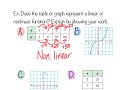
Linear vs Nonlinear Functions Concepts

Interactive Video
•
Mathematics
•
9th - 10th Grade
•
Practice Problem
•
Hard

Thomas White
FREE Resource
Read more
10 questions
Show all answers
1.
MULTIPLE CHOICE QUESTION
30 sec • 1 pt
What is the main difference between linear and nonlinear functions when comparing similar rectangles?
Linear functions have a constant rate of change, while nonlinear functions do not.
Nonlinear functions have a constant rate of change, while linear functions do not.
Linear functions are always larger than nonlinear functions.
Nonlinear functions are always larger than linear functions.
2.
MULTIPLE CHOICE QUESTION
30 sec • 1 pt
How can you identify a linear pattern when graphing the perimeter of rectangles?
The points form a curve.
The points form a zigzag pattern.
The points form a straight line.
The points are scattered randomly.
3.
MULTIPLE CHOICE QUESTION
30 sec • 1 pt
What happens to the graph of a nonlinear function when the rate of change is variable?
It remains constant.
It forms a zigzag pattern.
It forms a curve.
It forms a straight line.
4.
MULTIPLE CHOICE QUESTION
30 sec • 1 pt
In the comparison of a parachuter and a bowling ball, which one demonstrates a nonlinear descent?
Neither demonstrate nonlinear descent
The parachuter
The bowling ball
Both demonstrate nonlinear descent
5.
MULTIPLE CHOICE QUESTION
30 sec • 1 pt
What is the characteristic of a linear function's graph?
It has a variable rate of change.
It forms a straight line.
It forms a curve.
It has no rate of change.
6.
MULTIPLE CHOICE QUESTION
30 sec • 1 pt
How can you determine if a table shows a linear function?
By checking if the values are decreasing.
By checking if the values are increasing.
By checking if the rate of change is variable.
By checking if the rate of change is constant.
7.
MULTIPLE CHOICE QUESTION
30 sec • 1 pt
What is the main difference between simple and compound interest in terms of linearity?
Both simple and compound interest are nonlinear.
Simple interest is nonlinear, while compound interest is linear.
Both simple and compound interest are linear.
Simple interest is linear, while compound interest is nonlinear.
Access all questions and much more by creating a free account
Create resources
Host any resource
Get auto-graded reports

Continue with Google

Continue with Email

Continue with Classlink

Continue with Clever
or continue with

Microsoft
%20(1).png)
Apple

Others
Already have an account?
Similar Resources on Wayground

11 questions
Viral Events and Civics Knowledge
Interactive video
•
9th - 10th Grade
11 questions
Understanding the Quadratic Formula
Interactive video
•
9th - 12th Grade
11 questions
Exploring Arithmetic Sequences and Series
Interactive video
•
9th - 12th Grade
11 questions
Understanding Domain and Range
Interactive video
•
7th - 10th Grade
11 questions
Stationary Points and Inflection Analysis
Interactive video
•
9th - 10th Grade
11 questions
Trigonometric Functions and Their Inverses
Interactive video
•
9th - 10th Grade
11 questions
Graphing Inequalities and Parabolas
Interactive video
•
8th - 10th Grade
Popular Resources on Wayground
15 questions
Fractions on a Number Line

Quiz
•
3rd Grade
20 questions
Equivalent Fractions
Quiz
•
3rd Grade
25 questions
Multiplication Facts
Quiz
•
5th Grade
54 questions
Analyzing Line Graphs & Tables
Quiz
•
4th Grade
22 questions
fractions
Quiz
•
3rd Grade
20 questions
Main Idea and Details
Quiz
•
5th Grade
20 questions
Context Clues
Quiz
•
6th Grade
15 questions
Equivalent Fractions
Quiz
•
4th Grade
Discover more resources for Mathematics
20 questions
Graphing Inequalities on a Number Line
Quiz
•
6th - 9th Grade
18 questions
SAT Prep: Ratios, Proportions, & Percents
Quiz
•
9th - 10th Grade
12 questions
Exponential Growth and Decay
Quiz
•
9th Grade
12 questions
Parallel Lines Cut by a Transversal
Quiz
•
10th Grade
12 questions
Add and Subtract Polynomials
Quiz
•
9th - 12th Grade
15 questions
Combine Like Terms and Distributive Property
Quiz
•
8th - 9th Grade
20 questions
Function or Not a Function
Quiz
•
8th - 9th Grade
10 questions
Elijah McCoy: Innovations and Impact in Black History
Interactive video
•
6th - 10th Grade