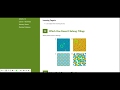
Identifying Tiling Patterns and Reasoning

Interactive Video
•
Mathematics, English, Other
•
6th - 7th Grade
•
Practice Problem
•
Hard

Thomas White
FREE Resource
Read more
10 questions
Show all answers
1.
MULTIPLE CHOICE QUESTION
30 sec • 1 pt
What is the main learning target of the lesson on tiling the plane?
To identify different colors in patterns
To explain the meaning of area
To memorize the names of shapes
To draw complex patterns
2.
MULTIPLE CHOICE QUESTION
30 sec • 1 pt
What is the primary focus of the 'Which One Doesn't Belong' activity?
Explaining and supporting your reasoning
Drawing the patterns accurately
Memorizing pattern names
Finding the single correct answer
3.
MULTIPLE CHOICE QUESTION
30 sec • 1 pt
What is the significance of reasoning in the 'Which One Doesn't Belong' activity?
It allows for multiple correct answers
It focuses on drawing skills
It ensures a single correct answer
It helps in memorizing patterns
4.
MULTIPLE CHOICE QUESTION
30 sec • 1 pt
Why might pattern A be considered as not belonging?
It has a different color scheme
It is the same as pattern B
It is larger than the others
It is made of circles
5.
MULTIPLE CHOICE QUESTION
30 sec • 1 pt
What is unique about pattern B that might make it not belong?
It uses only one shape
It is the smallest pattern
It has pentagons arranged in a flower shape
It is entirely blue
6.
MULTIPLE CHOICE QUESTION
30 sec • 1 pt
What is the reason pattern C might not belong?
It has a large size difference between shapes
It is made of triangles
It is the same as pattern D
It is entirely filled with gaps
7.
MULTIPLE CHOICE QUESTION
30 sec • 1 pt
Why might pattern D be considered as not belonging?
It is the same as pattern A
It is entirely red
It is made of hexagons
It has gaps and is not fully tiled
Access all questions and much more by creating a free account
Create resources
Host any resource
Get auto-graded reports

Continue with Google

Continue with Email

Continue with Classlink

Continue with Clever
or continue with

Microsoft
%20(1).png)
Apple

Others
Already have an account?
Popular Resources on Wayground

15 questions
Fractions on a Number Line

Quiz
•
3rd Grade
20 questions
Equivalent Fractions
Quiz
•
3rd Grade
25 questions
Multiplication Facts
Quiz
•
5th Grade
54 questions
Analyzing Line Graphs & Tables
Quiz
•
4th Grade
22 questions
fractions
Quiz
•
3rd Grade
20 questions
Main Idea and Details
Quiz
•
5th Grade
20 questions
Context Clues
Quiz
•
6th Grade
15 questions
Equivalent Fractions
Quiz
•
4th Grade
Discover more resources for Mathematics
22 questions
distributive property
Quiz
•
7th Grade
18 questions
Angle Relationships
Quiz
•
7th Grade
15 questions
Distributive Property & Review
Quiz
•
6th Grade
20 questions
Writing Algebraic Expressions
Quiz
•
6th Grade
20 questions
How Some Friendships Last — and Others Don’t Video Questions
Quiz
•
7th Grade
20 questions
Ratios/Rates and Unit Rates
Quiz
•
6th Grade
18 questions
Handbook Refresher Quiz
Quiz
•
7th Grade
20 questions
Graphing Inequalities on a Number Line
Quiz
•
6th - 9th Grade