
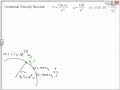
Gravitational Properties of Hypothetical Planets

Interactive Video
•
Physics
•
9th - 10th Grade
•
Practice Problem
•
Hard

Patricia Brown
FREE Resource
Read more
10 questions
Show all answers
1.
MULTIPLE CHOICE QUESTION
30 sec • 1 pt
What is the universal gravitational constant used in the equations for gravitational force?
6.67 * 10^-11 N m²/kg²
3.14
1.62 m/s²
9.8 m/s²
2.
MULTIPLE CHOICE QUESTION
30 sec • 1 pt
In the example problem, what is the mass of the hypothetical planet?
5.97 * 10^24 kg
1.1 * 10^25 kg
7.35 * 10^22 kg
2.0 * 10^30 kg
3.
MULTIPLE CHOICE QUESTION
30 sec • 1 pt
How far apart are the two small objects on the surface of the hypothetical planet?
100 meters
3 meters
10 meters
1 meter
4.
MULTIPLE CHOICE QUESTION
30 sec • 1 pt
What is the calculated gravitational field (g) on the surface of the hypothetical planet?
24.5 m/s²
9.8 m/s²
10.1 m/s²
1.62 m/s²
5.
MULTIPLE CHOICE QUESTION
30 sec • 1 pt
Using the calculated gravitational field, what is the weight of a 100 kg individual on the hypothetical planet?
1500 N
1010 N
1000 N
980 N
6.
MULTIPLE CHOICE QUESTION
30 sec • 1 pt
What is the main reason for the difference in force calculations between the two methods used?
Different gravitational constants
Rounding errors
Incorrect mass values
Different distances used
7.
MULTIPLE CHOICE QUESTION
30 sec • 1 pt
In the base case problem, what is the radius of the hypothetical planet compared to Earth?
Twice Earth's radius
Same as Earth
Three times Earth's radius
Half of Earth's radius
Access all questions and much more by creating a free account
Create resources
Host any resource
Get auto-graded reports

Continue with Google

Continue with Email

Continue with Microsoft
or continue with

%20(1).png)
Apple

Others
Already have an account?


