
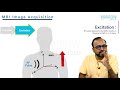
MRI Concepts and Relaxation Mechanisms

Interactive Video
•
Physics
•
10th - 12th Grade
•
Practice Problem
•
Hard

Patricia Brown
FREE Resource
Read more
10 questions
Show all answers
1.
MULTIPLE CHOICE QUESTION
30 sec • 1 pt
What is the term used to describe the wobbling movement of nuclei in a magnetic field?
Vibration
Oscillation
Rotation
Precession
2.
MULTIPLE CHOICE QUESTION
30 sec • 1 pt
What happens to the nuclei in the body when exposed to a strong external magnetic field?
They align randomly.
They align parallel or anti-parallel to the field.
They stop moving.
They become electrically charged.
3.
MULTIPLE CHOICE QUESTION
30 sec • 1 pt
What is the purpose of the pre-scan phase in MRI?
To align the patient's body
To determine the processing frequency of nuclei
To apply the magnetic field
To capture the final image
4.
MULTIPLE CHOICE QUESTION
30 sec • 1 pt
During the excitation phase, what happens to the net magnetic vector?
It disappears.
It remains stationary.
It flips into the x-y plane.
It aligns with the z-axis.
5.
MULTIPLE CHOICE QUESTION
30 sec • 1 pt
What is T1 relaxation also known as?
Longitudinal relaxation
Transverse relaxation
Spin-lattice relaxation
Spin-spin relaxation
6.
MULTIPLE CHOICE QUESTION
30 sec • 1 pt
How is T2 relaxation different from T1 relaxation?
It occurs along the z-axis.
It does not emit any signal.
It is slower than T1 relaxation.
It involves the loss of transverse magnetization.
7.
MULTIPLE CHOICE QUESTION
30 sec • 1 pt
What percentage of transverse magnetization is lost during T2 relaxation?
100%
63%
50%
75%
Access all questions and much more by creating a free account
Create resources
Host any resource
Get auto-graded reports

Continue with Google

Continue with Email

Continue with Classlink

Continue with Clever
or continue with

Microsoft
%20(1).png)
Apple

Others
Already have an account?

