
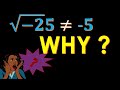
Understanding Square Roots of Negative Numbers

Interactive Video
•
Mathematics
•
9th - 10th Grade
•
Practice Problem
•
Hard

Patricia Brown
FREE Resource
Read more
10 questions
Show all answers
1.
MULTIPLE CHOICE QUESTION
30 sec • 1 pt
Why is the square root of 25 equal to 5?
Because 25 is an even number
Because 5 is the only factor of 25
Because 5 is a prime number
Because 5 multiplied by 5 equals 25
2.
MULTIPLE CHOICE QUESTION
30 sec • 1 pt
What happens when you assume the square root of -36 is 6?
6 times 6 equals 0
6 times 6 equals -36
6 times 6 equals 36
6 times 6 equals -6
3.
MULTIPLE CHOICE QUESTION
30 sec • 1 pt
Why can't the square root of -36 be 6?
Because 6 times 6 equals 36, not -36
Because 6 is not a real number
Because 6 is an odd number
Because 6 is greater than -36
4.
MULTIPLE CHOICE QUESTION
30 sec • 1 pt
What is the result of multiplying -6 by -6?
-36
0
-6
36
5.
MULTIPLE CHOICE QUESTION
30 sec • 1 pt
Why does assigning -6 as the square root of -36 fail?
Because -6 is not a real number
Because -6 is less than -36
Because -6 times -6 equals 36, not -36
Because -6 is an even number
6.
MULTIPLE CHOICE QUESTION
30 sec • 1 pt
What does the failure of these assumptions suggest?
That all numbers are imaginary
That positive numbers are easier to work with
That we need to develop better rules for negative numbers
That negative numbers cannot have square roots
7.
MULTIPLE CHOICE QUESTION
30 sec • 1 pt
What is the main challenge with finding the square root of a negative number?
Negative numbers are larger than positive numbers
Negative numbers are always imaginary
The result is not straightforward like positive numbers
Negative numbers are not real
Access all questions and much more by creating a free account
Create resources
Host any resource
Get auto-graded reports

Continue with Google

Continue with Email

Continue with Classlink

Continue with Clever
or continue with

Microsoft
%20(1).png)
Apple

Others
Already have an account?

