
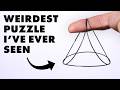
Mathematical Knots and Their Properties

Interactive Video
•
Mathematics
•
9th - 10th Grade
•
Practice Problem
•
Hard

Patricia Brown
FREE Resource
Read more
10 questions
Show all answers
1.
MULTIPLE CHOICE QUESTION
30 sec • 1 pt
Who invented the puzzle discussed in the video?
William Thompson
Mark Pauley
Michele Vidulis
Joel Langer
2.
MULTIPLE CHOICE QUESTION
30 sec • 1 pt
What is the main difference between a regular knot and a mathematical knot?
A regular knot has no loose ends.
A regular knot is made of elastic material.
A mathematical knot can be untangled easily.
A mathematical knot is a loop of string that can't be untangled.
3.
MULTIPLE CHOICE QUESTION
30 sec • 1 pt
What material is used to create physical realizations of mathematical knots in the video?
Elastic ribbon
Plastic string
Nitinol wire
Copper wire
4.
MULTIPLE CHOICE QUESTION
30 sec • 1 pt
What is a stable configuration in the context of elastic knots?
A configuration that is unstable
A configuration that can be easily untangled
A configuration that remains unchanged without friction
A configuration that is always flat
5.
MULTIPLE CHOICE QUESTION
30 sec • 1 pt
How do Mark and Michele find stable configurations of knots?
By using a periodic table of elements
By observing natural knots
By using 3D simulation software
By manually tying knots
6.
MULTIPLE CHOICE QUESTION
30 sec • 1 pt
What is the designation of the knot with nine crossings discussed in the video?
9-40 knot
Cinquefoil knot
Trefoil knot
Figure 8 knot
7.
MULTIPLE CHOICE QUESTION
30 sec • 1 pt
What is a unique feature of the 9-40 knot?
It is always flat.
It has a stable bow tie configuration.
It is more springy due to its complexity.
It is the simplest knot.
Access all questions and much more by creating a free account
Create resources
Host any resource
Get auto-graded reports

Continue with Google

Continue with Email

Continue with Classlink

Continue with Clever
or continue with

Microsoft
%20(1).png)
Apple

Others
Already have an account?

