
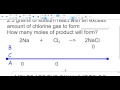
Stoichiometry and BCA Table Concepts

Interactive Video
•
Chemistry
•
9th - 10th Grade
•
Practice Problem
•
Hard

Patricia Brown
FREE Resource
Read more
10 questions
Show all answers
1.
MULTIPLE CHOICE QUESTION
30 sec • 1 pt
What is the first step in solving a stoichiometry problem involving sodium and chlorine gas?
Calculate the molar mass of sodium
Write a balanced chemical equation
Identify the limiting reactant
Determine the amount of chlorine gas
2.
MULTIPLE CHOICE QUESTION
30 sec • 1 pt
What type of reaction occurs between sodium and chlorine gas?
Decomposition
Synthesis
Single replacement
Combustion
3.
MULTIPLE CHOICE QUESTION
30 sec • 1 pt
Why is it important to balance the chemical equation before proceeding with stoichiometry calculations?
To ensure the reaction is spontaneous
To calculate the reaction rate
To determine the limiting reactant
To ensure the conservation of mass
4.
MULTIPLE CHOICE QUESTION
30 sec • 1 pt
What is the primary unit used in a BCA table?
Atoms
Grams
Liters
Moles
5.
MULTIPLE CHOICE QUESTION
30 sec • 1 pt
Why must grams be converted to moles before using the BCA table?
Because moles are easier to measure
Because grams are too large for calculations
Because moles represent the number of particles
Because grams are not a standard unit
6.
MULTIPLE CHOICE QUESTION
30 sec • 1 pt
What is the molar mass of sodium used in the conversion from grams to moles?
35.5 g/mol
40 g/mol
23 g/mol
11 g/mol
7.
MULTIPLE CHOICE QUESTION
30 sec • 1 pt
How do you solve for moles when given grams and molar mass?
Multiply grams by molar mass
Divide grams by molar mass
Add grams to molar mass
Subtract molar mass from grams
Access all questions and much more by creating a free account
Create resources
Host any resource
Get auto-graded reports

Continue with Google

Continue with Email

Continue with Classlink

Continue with Clever
or continue with

Microsoft
%20(1).png)
Apple

Others
Already have an account?

