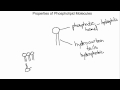
Phospholipid Structure and Function

Interactive Video
•
Biology
•
9th - 10th Grade
•
Practice Problem
•
Hard

Patricia Brown
FREE Resource
Read more
10 questions
Show all answers
1.
MULTIPLE CHOICE QUESTION
30 sec • 1 pt
What are the main components of a phospholipid molecule?
Two phosphate heads and two hydrocarbon tails
A phosphate head and one hydrocarbon tail
A phosphate head and two hydrocarbon tails
Two phosphate heads and one hydrocarbon tail
2.
MULTIPLE CHOICE QUESTION
30 sec • 1 pt
Which part of the phospholipid molecule is attracted to water?
Neither the phosphate head nor hydrocarbon tails
Both the phosphate head and hydrocarbon tails
Phosphate head
Hydrocarbon tails
3.
MULTIPLE CHOICE QUESTION
30 sec • 1 pt
What term describes the water-repelling nature of the hydrocarbon tails?
Amphipathic
Hydrophobic
Polar
Hydrophilic
4.
MULTIPLE CHOICE QUESTION
30 sec • 1 pt
How do phospholipid molecules arrange themselves in water?
In a single layer with heads facing each other
Randomly scattered throughout the water
In a single layer with tails facing the water
In a double layer with tails facing each other
5.
MULTIPLE CHOICE QUESTION
30 sec • 1 pt
What is the primary reason for the formation of a bilayer by phospholipids in water?
The hydrophilic nature of the phosphate heads and hydrophobic nature of the tails
The hydrophobic nature of both the phosphate heads and tails
The hydrophobic nature of the phosphate heads
The hydrophilic nature of the hydrocarbon tails
6.
MULTIPLE CHOICE QUESTION
30 sec • 1 pt
What type of interactions do hydrocarbon tails form with each other?
Weak hydrophobic interactions
Hydrogen bonds
Ionic bonds
Strong covalent bonds
7.
MULTIPLE CHOICE QUESTION
30 sec • 1 pt
Why are phosphate heads found on the outside of the bilayer?
They are positively charged
They form strong bonds with hydrocarbon tails
They are attracted to water
They repel water
Access all questions and much more by creating a free account
Create resources
Host any resource
Get auto-graded reports

Continue with Google

Continue with Email

Continue with Classlink

Continue with Clever
or continue with

Microsoft
%20(1).png)
Apple

Others
Already have an account?
Similar Resources on Wayground

6 questions
Calvin Cycle Quiz
Interactive video
•
9th - 10th Grade
11 questions
Chemistry of Life Quiz
Interactive video
•
9th - 10th Grade
11 questions
Darwin Day Special: Understanding Sexual Selection
Interactive video
•
9th - 10th Grade
11 questions
Cellular Respiration Quiz
Interactive video
•
9th - 10th Grade
9 questions
Balancing Combustion Reactions
Interactive video
•
9th - 10th Grade
6 questions
CLEAN : Mammoth field fires up Norway's oil industry
Interactive video
•
9th - 10th Grade
10 questions
mengenal paus
Interactive video
•
KG
11 questions
Independent and Mutually Exclusive Events
Interactive video
•
9th - 10th Grade
Popular Resources on Wayground
15 questions
Fractions on a Number Line

Quiz
•
3rd Grade
20 questions
Equivalent Fractions
Quiz
•
3rd Grade
25 questions
Multiplication Facts
Quiz
•
5th Grade
54 questions
Analyzing Line Graphs & Tables
Quiz
•
4th Grade
22 questions
fractions
Quiz
•
3rd Grade
20 questions
Main Idea and Details
Quiz
•
5th Grade
20 questions
Context Clues
Quiz
•
6th Grade
15 questions
Equivalent Fractions
Quiz
•
4th Grade
Discover more resources for Biology
20 questions
Cell Organelles
Quiz
•
9th Grade
14 questions
Ecological Succession: Primary and Secondary
Quiz
•
9th Grade
22 questions
Human Body Systems Overview
Quiz
•
9th Grade
25 questions
photosynthesis and cellular respiration
Quiz
•
9th Grade
21 questions
Meiosis Vs Mitosis
Quiz
•
10th Grade
10 questions
Comparing Mitosis and Meiosis: Key Differences and Stages
Interactive video
•
6th - 10th Grade
13 questions
Amoeba Sisters Viruses Video quiz
Interactive video
•
9th Grade
20 questions
Cladogram Practice
Quiz
•
10th Grade