
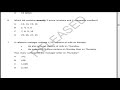
Prime and Composite Numbers Concepts

Interactive Video
•
Mathematics
•
6th - 7th Grade
•
Practice Problem
•
Hard

Patricia Brown
FREE Resource
Read more
10 questions
Show all answers
1.
MULTIPLE CHOICE QUESTION
30 sec • 1 pt
What is the main task described in the problem statement?
Identify a list with two prime and two composite numbers.
Identify a list with only prime numbers.
Identify a list with three prime numbers.
Identify a list with only composite numbers.
2.
MULTIPLE CHOICE QUESTION
30 sec • 1 pt
Which of the following is a characteristic of a prime number?
It is always greater than 10.
It has exactly two distinct factors: 1 and itself.
It is always an even number.
It has more than two factors.
3.
MULTIPLE CHOICE QUESTION
30 sec • 1 pt
Why is 13 considered a prime number?
Because it is an even number.
Because it is less than 20.
Because it can be divided by 1 and 13 only.
Because it is a multiple of 3.
4.
MULTIPLE CHOICE QUESTION
30 sec • 1 pt
What makes a number composite?
It is always an odd number.
It has factors other than 1 and itself.
It is a prime number.
It has only one factor.
5.
MULTIPLE CHOICE QUESTION
30 sec • 1 pt
Why are all even numbers other than 2 considered composite?
Because they have no factors.
Because they are prime numbers.
Because they are divisible by 2.
Because they are odd numbers.
6.
MULTIPLE CHOICE QUESTION
30 sec • 1 pt
Which numbers in list A are composite?
13 and 14
14, 15, and 16
13 and 15
2 and 7
7.
MULTIPLE CHOICE QUESTION
30 sec • 1 pt
Which list contains exactly two prime numbers and two composite numbers?
List A
List C
List D
List B
Access all questions and much more by creating a free account
Create resources
Host any resource
Get auto-graded reports

Continue with Google

Continue with Email

Continue with Classlink

Continue with Clever
or continue with

Microsoft
%20(1).png)
Apple

Others
Already have an account?


